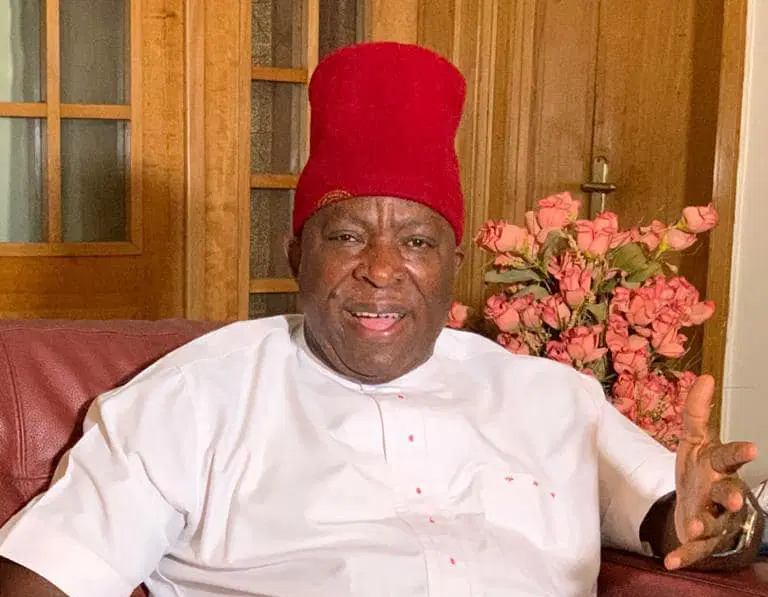
With several government projects still awaiting completion, Senator Victor Umeh has questioned the Federal Government’s decision to seek fresh foreign loans, arguing that Nigerians deserve an explanation of how previously approved funds have been spent.
Umeh, who represents Anambra Central in the Senate, raised the concerns during an appearance on Politics Today on Tuesday, October 27, 2026.
The lawmaker said the country’s continued reliance on borrowing was difficult to understand, particularly when the government had reported improved revenue collections.
He argued that additional loans should not become the automatic response to financial challenges when existing resources and earlier borrowing had yet to produce visible results.
His remarks followed President Bola Tinubu’s request for National Assembly approval to obtain approximately $20.52 billion and €1.05 billion in external loans.
The proposed borrowing forms part of the Federal Government’s 2026–2027 Supplementary External Borrowing Plan.
According to the President, the funds would support infrastructure development and programmes covering agriculture, healthcare, education, water supply and other priority sectors.
Senate President Godswill Akpabio presented the request during Tuesday’s plenary before lawmakers referred it to the Committee on Local and Foreign Debts for consideration.
Umeh, however, insisted that the government should first account for the progress made with money previously approved for development projects.
He expressed concern that contractors were still awaiting payment despite the government’s repeated borrowing arrangements.
The senator also criticised what he described as the simultaneous operation of three budgets without satisfactory implementation of their capital components.
He claimed that work on the 2026 capital budget had not commenced, even though October was nearing its end.
Turning to railway development, Umeh questioned the status of the Eastern Rail Line, which he said had received a $3 billion provision under an earlier borrowing approval.
He maintained that reconstruction work had yet to begin and demanded clarification on whether the proposed financing had been accessed.
The lawmaker also linked his concerns to the economic difficulties facing ordinary Nigerians.
He cited petrol prices of ₦1,410 per litre and diesel prices of approximately ₦1,889 per litre as examples of rising costs affecting households and businesses.
Umeh argued that the public should be able to identify practical improvements resulting from government borrowing.
He maintained that stronger revenue performance should translate into better infrastructure and services rather than repeated demands for additional loans.
Asked about the possibility of opposition lawmakers blocking the proposal, the senator acknowledged that government supporters held a numerical advantage in the National Assembly.
Nevertheless, he maintained that the government must explain its previous borrowing and demonstrate how additional debt would benefit Nigerians.
The dispute now places renewed attention on the relationship between public borrowing, project delivery and accountability.