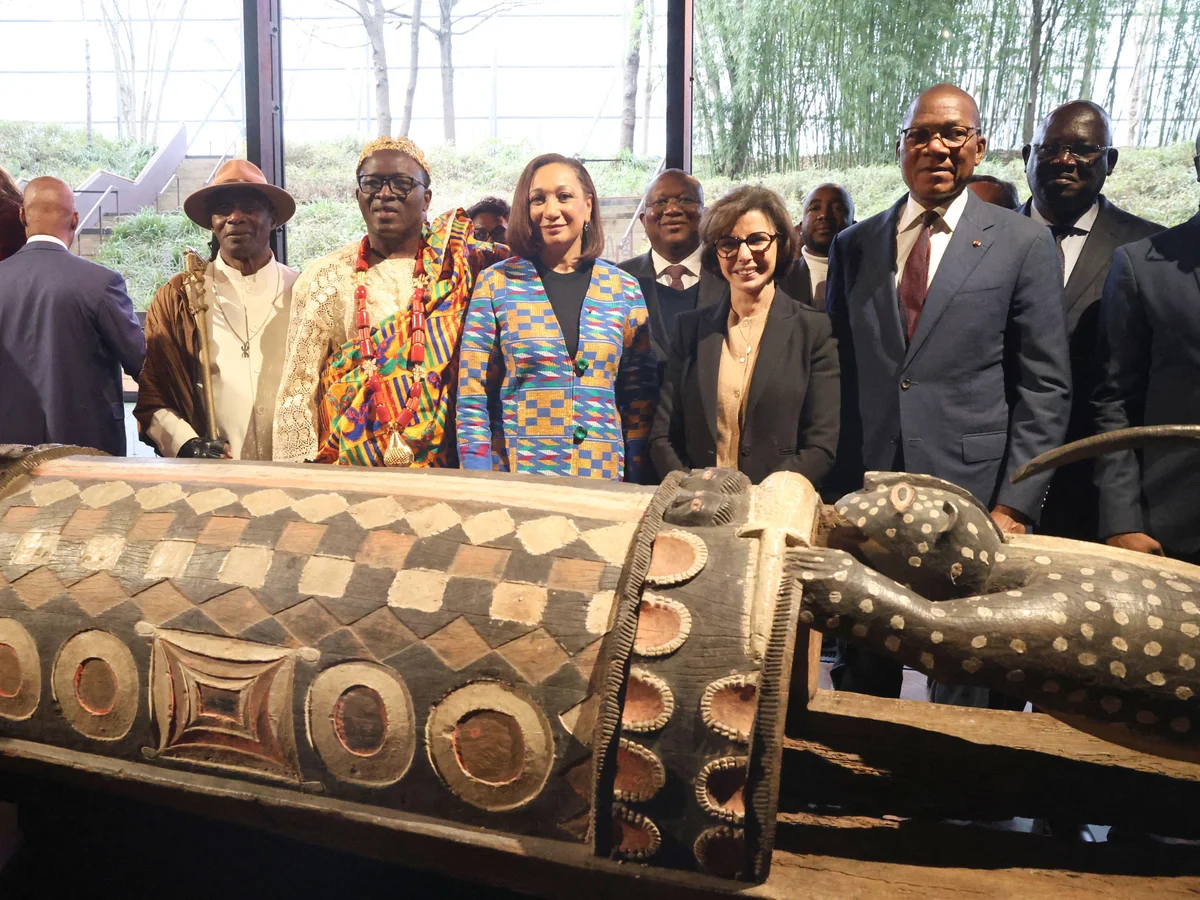
After more than a century abroad, a revered Ivorian drum has returned to the country where it once served as a powerful voice of the Atchan people, bringing home an important piece of cultural heritage removed during the colonial era.
Known as the Djidji Ayôkwé, the large wooden “talking drum” was formally received in Abidjan after being returned by France. Its arrival was welcomed by government officials, traditional representatives and members of the Atchan community, for whom the instrument carries deep historical and spiritual significance.
The artefact was taken from Ivory Coast by French colonial authorities in 1916. It was later transferred to France and eventually became part of the collection of the Musée du Quai Branly-Jacques Chirac in Paris.
The drum was not simply a musical instrument. Among the Atchan people of the Abidjan area, its distinctive sound was traditionally used to communicate across communities, announce important developments and bring people together.
French authorities formally cleared the way for its restitution after legislation was adopted in July 2025. The law removed the object from France’s public collection and authorised its return to the Ivorian state.
The return was particularly significant because the Djidji Ayôkwé is regarded as an important symbol of Atchan identity. French cultural authorities have described the object as weighing roughly 430 kilogrammes, making its transportation and preservation a considerable logistical exercise.
Rather than immediately placing it on public display, Ivorian authorities are taking measures to protect the historic object. The wooden drum requires a gradual adjustment to the country’s warmer and more humid environment after spending decades in European museum conditions.
Officials have indicated that the artefact will eventually be displayed at the Museum of Civilizations of Côte d’Ivoire in Abidjan, allowing members of the public to see an object that has been outside the country for generations.
The homecoming also has wider significance for relations between France and its former African colonies. Ivory Coast has joined other African countries seeking the return of cultural objects removed during the colonial period and subsequently held in European institutions.
The restitution has been described in reports as France’s first official return of a cultural artefact to Ivory Coast, giving the event additional historical importance.
For Ivorian authorities and cultural leaders, the return goes beyond the recovery of an old object. It restores an artefact to the community whose ancestors created and used it, while providing an opportunity for younger generations to learn about its original meaning.
The Djidji Ayôkwé’s journey also reflects the growing international debate over the ownership and future of African cultural heritage held in foreign museums.
Its return therefore represents both a cultural homecoming and a broader step in efforts to address the legacy of colonial-era removals. More than 100 years after it was taken away, the sacred drum is once again in Ivory Coast, where its history can be preserved within the cultural setting that gave it meaning.