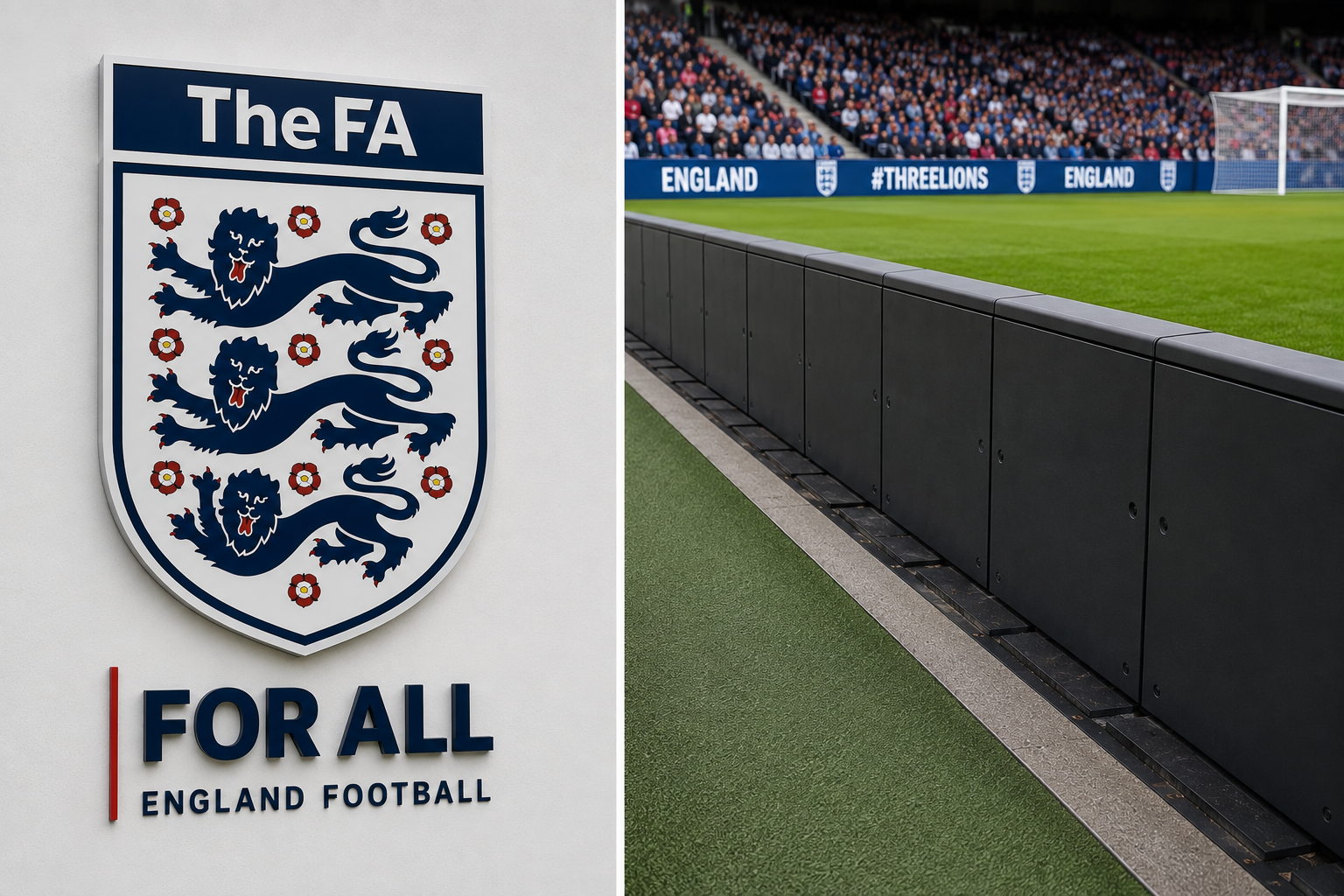
The death of former Arsenal academy player Billy Vigar has prompted the Football Association (FA) to impose new safeguards around pitches in England, with clubs facing tougher requirements over the use and protection of hard perimeter structures.
The revised regulations will take effect during the 2026-27 season and cover clubs across the men’s National League System from Steps 1 to 6, as well as the women’s National League at Tiers 3 and 4.
Under the new framework, exposed walls and other rigid barriers constructed from materials including concrete, brick and breeze blocks will not be permitted immediately beside playing areas. Clubs that cannot remove such structures will be expected to install suitable protection to reduce the danger they pose.
The policy follows an investigation into the circumstances surrounding Vigar’s death. The 21-year-old sustained a severe head injury while representing Chichester City against Wingate & Finchley in an Isthmian League Premier Division fixture in September 2025. He subsequently died from the injury.
His death intensified a debate that had already been developing within English football over the proximity of solid barriers to the touchline. Players, supporters and campaigners subsequently urged governing bodies to make ground safety a greater priority.
The FA responded by commissioning a review involving independent health and safety professionals. The assessment examined the risks associated with perimeter structures and informed the new requirements now being introduced across the affected competitions.
Clubs will have to examine their grounds and determine what measures are necessary to meet the revised standards. In some cases, this could mean removing a wall; elsewhere, suitable padding or another protective solution may be required.
Concerns about hard barriers are not new. Former professional Alex Fletcher suffered a serious head injury after colliding with a concrete wall while playing for Bath City in 2022. His experience had previously raised questions about whether football authorities were doing enough to address similar hazards.
The campaign for improved protection gained further momentum after Vigar’s death, attracting significant public support. Calls for the removal or modification of dangerous structures became louder among sections of the football community.
Financial considerations have also been taken into account. The FA and Premier League are providing assistance through existing funding arrangements, including the Premier League Stadium Fund, to help qualifying lower-league clubs undertake necessary improvements.
The new approach is designed not only to deal with existing hazards but also to encourage clubs to identify potential dangers before players are injured. Ground operators will have greater responsibility for assessing the risks presented by structures around their playing surfaces.
The changes represent a notable shift in safety requirements at the lower levels of English football, where clubs often operate with more modest facilities and financial resources than those at the professional elite level.
For the FA, the objective is to reduce the potential consequences of players colliding with fixed objects while competing near the boundaries of the pitch. For clubs, compliance will require inspections, possible construction work and, in some cases, additional expenditure.
Vigar’s death has consequently become a catalyst for changes extending beyond one club or competition. The new regulations are intended to make pitch surroundings safer throughout the National League System and reduce the risks posed by unprotected hard structures.