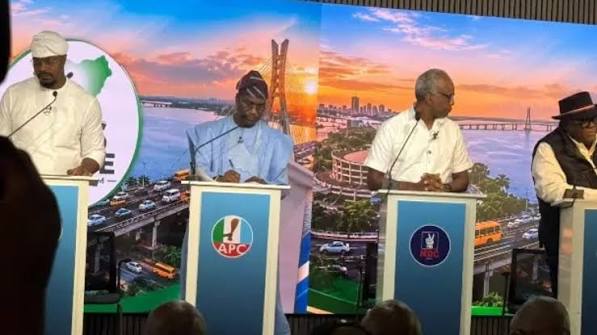
Affordable housing, traffic congestion and public infrastructure took centre stage as four candidates seeking to govern Lagos State in 2027 presented different approaches to addressing the challenges facing residents.
The candidates shared their plans at a governorship debate organised by the Nigeria Debate Consortium on Sunday, November 8, giving voters an opportunity to hear how each intends to manage the state’s development.
Those who participated were Obafemi Hamzat of the All Progressives Congress (APC), Gbadebo Rhodes-Vivour of the African Democratic Congress (ADC), Funso Doherty of the Nigeria Democratic Congress (NDC) and Deji Doherty of the Peoples Democratic Party (PDP).
Housing affordability featured prominently, with the candidates offering different proposals to help residents secure accommodation.
Rhodes-Vivour pledged to deliver at least 100,000 housing units over four years, with particular attention to people who struggle to afford decent homes.
He also called for development projects to be distributed more widely across the state instead of being concentrated in selected locations.
Hamzat, the incumbent deputy governor, defended the housing projects undertaken by the current administration and proposed expanding access to mortgage facilities.
Under his plan, eligible residents would be able to make an initial payment and settle the remaining cost of their homes over an agreed period.
He also promised to strengthen enforcement of existing rules against landlords demanding more than one year’s rent in advance.
Deji Doherty suggested a different approach, proposing that the government should construct residential buildings and make them available to residents through rental arrangements.
Transport was another major issue discussed during the debate.
Hamzat outlined plans to expand Lagos’s public bus fleet to 4,000 compressed natural gas-powered vehicles, targeting the transportation of one million passengers each day.
He also proposed introducing 77 electric ferries while improving connections between buses, trains and waterways.
Rhodes-Vivour advocated improvements to ferry terminals, additional rail connections and better roads linking communities across Lagos.
Deji Doherty, meanwhile, identified deteriorating roads, heavy-duty vehicles and inadequate transport facilities as problems that require attention.
Education also featured in the discussion, with Funso Doherty promising to make public schooling genuinely free by removing examination-related charges that increase the financial burden on parents.
The candidates further addressed flooding, healthcare, government finances and other development concerns.
Although they discussed many of the same challenges, their proposals reflected different approaches to housing provision, transport investment and public service delivery.
The debate gave Lagos residents a clearer picture of the commitments being made ahead of the election, while leaving questions about how the various projects would be funded and implemented.