

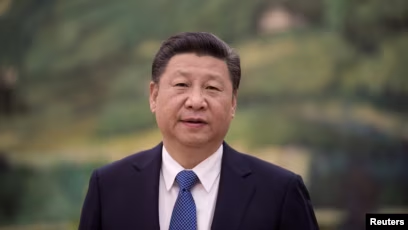
Chinese President Xi Jinping has convened hundreds of senior Communist Party officials for a crucial four-day meeting in Beijing aimed at strengthening political discipline, tackling corruption and reinforcing government accountability ahead of a major leadership reshuffle in 2027.
The closed-door gathering, known as the Fifth Plenum of the Communist Party’s 20th Central Committee, began on Monday and will continue until Thursday, October 29.
Approximately 300 senior party officials are participating in discussions expected to shape China’s political direction and internal governance.
According to state news agency Xinhua, Xi opened the meeting by presenting a draft policy document outlining measures to strengthen what Beijing describes as “full and rigorous Party self-governance”.
The proposals seek to improve officials’ performance, tighten supervision, prevent abuse of power and ensure that government institutions implement decisions made by the central leadership.
The meeting comes amid an extensive anti-corruption campaign that has resulted in the investigation and removal of numerous senior officials, including powerful military commanders.
Since assuming power in 2012, Xi has made combating corruption a defining feature of his leadership, although critics argue that the campaign has also strengthened his political authority.
Recent investigations have significantly reduced the Communist Party’s senior leadership ranks.
According to the Asia Society Policy Institute, only about 77.4 percent of the Central Committee members selected in 2022 are currently eligible to attend the gathering.
The crackdown has also affected China’s military leadership, raising questions among analysts about institutional stability and the consequences for military operations.
Xi has repeatedly criticised officials accused of ignoring central directives, pursuing personal interests or failing to implement government policies.
Political analysts believe the latest meeting could introduce stricter monitoring of public spending, major infrastructure projects and administrative performance.
Ruby Osman, a senior policy adviser at the Tony Blair Institute for Global Change, said the campaign increasingly reflects efforts to ensure future generations of officials follow Xi’s political priorities.
The talks are also taking place as China confronts weak domestic consumption, prolonged difficulties in its property market and economic tensions with the United States.
Attention is turning towards the Communist Party’s 2027 national congress, when Xi is widely expected to seek a fourth term as party leader.
Although significant leadership appointments remain possible, analysts do not anticipate a clear succession announcement.
For now, the gathering places party discipline, political loyalty and institutional accountability at the centre of China’s preparations for its next leadership cycle.



















