

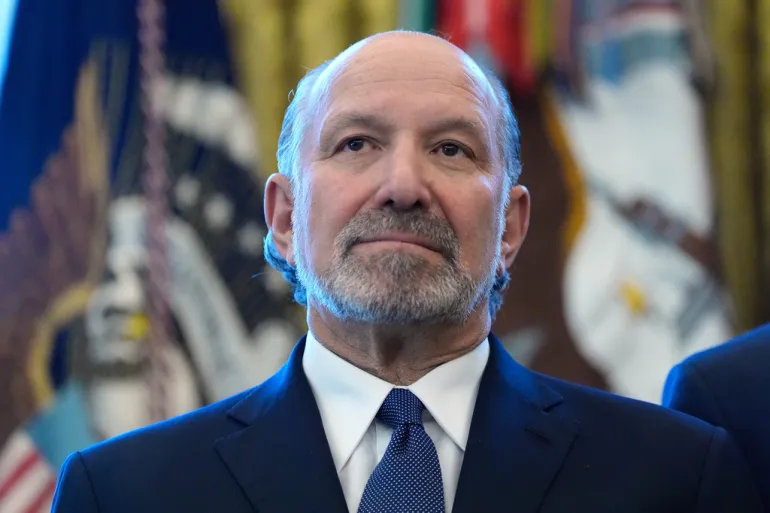
US Commerce Secretary Howard Lutnick has come under fresh scrutiny over restrictions on advanced computer chip exports to China, with reports indicating that officials within the White House have discussed his continued role in President Donald Trump’s administration.
The reported discussions came to light on Thursday, November 12, 2026, as questions mounted over the Commerce Department’s approach to sensitive American technology.
Two people familiar with the matter indicated that senior administration officials had considered whether Lutnick should remain in charge of the department.
At the centre of the disagreement is Washington’s handling of export restrictions involving Nvidia, whose advanced processors are widely used to develop artificial intelligence systems.
Some lawmakers believe existing safeguards have not gone far enough to prevent sophisticated American technology from reaching Chinese businesses considered potential security threats.
Their concerns include reported delays in expanding a trade blacklist designed to limit certain foreign companies’ access to US technology.
Chinese artificial intelligence company DeepSeek and memory chip manufacturer CXMT are among the businesses mentioned in discussions about additional restrictions.
National security concerns had reportedly been raised before decisions on the proposed measures were delayed.
Lutnick has also faced allegations that he held back efforts to strengthen controls against companies suspected of transferring Nvidia chips to China through indirect channels.
Congressional attention has extended to Megaspeed, a Singapore-based company reported to have purchased more than $4.8 billion worth of Nvidia chips since June 2024.
Those transactions have prompted questions about the movement of advanced American processors through overseas commercial networks.
Democratic Senators Elizabeth Warren and Chris Coons have requested the preservation of records connected to Nvidia’s exports to China and related security matters.
Their intervention forms part of wider congressional efforts to examine how the administration oversees sales of technology with potential national security implications.
Republican Senator John Kennedy has also sought answers from Lutnick about the Commerce Department’s decisions.
Although Kennedy has questioned the department’s approach, he has not explicitly called for Lutnick to be dismissed.
Another Republican lawmaker, Senator Tom Cotton, has pressed for stronger restrictions involving Chinese memory chip producer CXMT.
The dispute has brought renewed attention to the challenge of regulating advanced semiconductor exports while American technology companies maintain international business operations.
Questions have also been raised about reported links between Megaspeed executive Alice Huang and allegations involving Chinese intelligence.
Those allegations have not been established as fact and should not be treated as evidence of wrongdoing.
Separate claims concerning Nvidia chief executive Jensen Huang’s personal relationship with Alice Huang, including reports of his resignation, remain unverified.
Despite the controversy, the White House has made no official announcement about removing Lutnick.
An administration official has maintained that Trump continues to have confidence in the Commerce Secretary.
Lutnick, a former Wall Street executive who helped lead Trump’s presidential transition, remains in office as scrutiny of US technology export decisions continues.



















