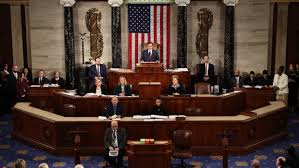
WASHINGTON, D.C. — A heated hearing of the US House Foreign Affairs Subcommittee on Africa yesterday put fresh pressure on the Nigerian government over worsening insecurity and allegations of a “Christian genocide” in the country.
Chaired by Rep. Chris Smith (R–New Jersey), the session examined President Donald Trump’s recent redesignation of Nigeria as a “Country of Particular Concern” over religious freedom violations, a move that opens the door to sanctions and other punitive measures.
Smith said religious freedom in Nigeria must be demonstrable, insisting that Abuja must go beyond rhetoric and “prosecute bandits who are killing Christians and responsible for kidnapping,” especially in the North-East and Middle Belt.
State Department officials Jacob McGee and Jonathan Pratt told lawmakers that thousands of Christians have been killed in Nigeria in the last two years and urged the Nigerian government to strengthen protections for all faith communities. They warned that weak accountability fuels impunity and further violence.
However, experts cautioned against oversimplifying Nigeria’s complex security crisis as purely religious. Oge Onubogu, Director of the Africa Program at the Center for Strategic and International Studies, said multiple, “braided” drivers — including terrorism, farmer–herder conflict, banditry and governance failures — overlap, and that framing the crisis solely as genocide risks misdiagnosis and dangerous policy responses.
Earlier this year, Bishop Wilfred Anagbe of Makurdi had told US lawmakers that Nigeria has become “the deadliest place on earth to be a Christian,” citing relentless attacks by Boko Haram, Islamic State West Africa Province (ISWAP) and armed Fulani militants, with entire Christian communities displaced and farmland destroyed.
On the sidelines of the hearing, Congressman Riley Moore met a high-level Nigerian delegation led by National Security Adviser Nuhu Ribadu, alongside the Inspector-General of Police Kayode Egbetokun, Attorney-General Lateef Fagbemi, Chief of Defence Staff Gen. Christopher Musa Olufemi, and Chief of Defence Intelligence Lt-Gen Emmanuel Undiandeye, among others.
Moore described the meeting as “frank, honest, and productive,” saying the US expects “tangible steps” to ensure Christians are not subjected to violence, displacement or death “simply for believing in our Lord and Savior Jesus Christ.” He said Washington is ready to cooperate with Nigeria on counterterrorism, security assistance and protection of vulnerable communities, but warned that religious violence “cannot continue unchecked.”
While Trump has hinted at sanctions and even potential military options if Abuja fails to act decisively, other lawmakers, including Rep. Sara Jacobs, have branded such talk “reckless”, arguing that any unilateral US military intervention in Nigeria would be illegal and could worsen the situation on the ground.