

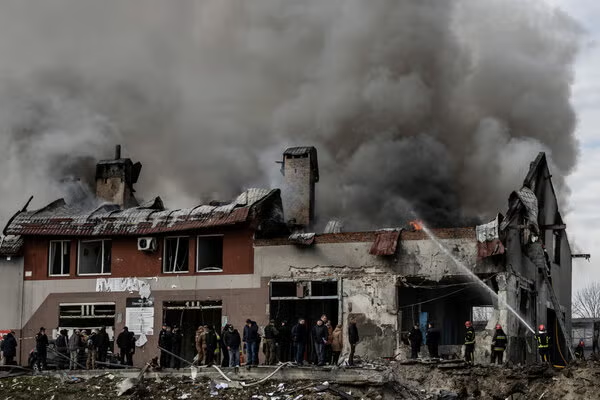
KYIV, UKRAINE — Russia has intensified its aerial bombardment of Ukraine, launching ballistic missiles carrying cluster warheads against the capital as Ukrainian troops report significant territorial gains along the eastern front, highlighting the continuing violence despite renewed diplomatic efforts to end the war.
The latest assault, carried out overnight on October 21–22, targeted Kyiv and several other regions, killing at least two people and injuring more than 30, including children, according to Ukrainian authorities.
President Volodymyr Zelenskyy said Russian forces fired at least 21 ballistic missiles in three waves, including three equipped with cluster warheads designed to disperse smaller explosives over a wide area.
One missile struck the historic Pechersk district, damaging buildings near the Kyiv-Pechersk Lavra and the Holy Presentation Monastery.
Residential properties, shops, transport infrastructure and emergency service facilities were also damaged.
Zelenskyy accused Moscow of deliberately deploying weapons capable of causing extensive civilian casualties.
Russia’s Defence Ministry maintained that its strikes targeted facilities involved in manufacturing Ukrainian drones and missiles.
The attacks coincided with Ukrainian claims of improving battlefield conditions.
Zelenskyy said Ukrainian troops had recovered substantial territory since the beginning of autumn, challenging Russian claims of continued advances.
According to the Washington-based Institute for the Study of War, Russia has experienced a net territorial loss of approximately 241 square kilometres in Ukraine since September 1.
The organisation attributed part of Ukraine’s progress to Operation Vivaldi, a counteroffensive that disrupted Russian efforts to encircle strategically important Ukrainian defensive positions in Donetsk.
Ukrainian commander Andriy Biletskyi said his forces had eliminated a Russian bridgehead near the Zherebets River, enabling them to shorten defensive lines and concentrate military resources.
Meanwhile, Moscow has intensified attacks on Ukraine’s energy infrastructure as colder weather approaches.
Zelenskyy said Russian forces had struck more than 170 Ukrainian energy facilities since October 11, raising concerns about electricity and heating supplies.
The escalating hostilities come as the United States attempts to revive negotiations between Moscow and Kyiv.
US envoy Steve Witkoff recently met Russian President Vladimir Putin, while discussions continue over possible trilateral peace talks in November.
However, major disagreements remain over territorial control, security guarantees and the conditions for ending military operations.
Despite Ukraine’s reported battlefield gains, neither side has secured a decisive breakthrough.
For civilians facing missile attacks, damaged infrastructure and displacement, the continuing violence underscores the urgency of diplomatic efforts and effective protection from further attacks.



















