

KYIV/MOSCOW
The Russia-Ukraine war has entered another intense phase, with Moscow unleashing one of its deadliest recent aerial attacks across Ukraine while Kyiv expands long-range strikes against Russian oil infrastructure and military targets.
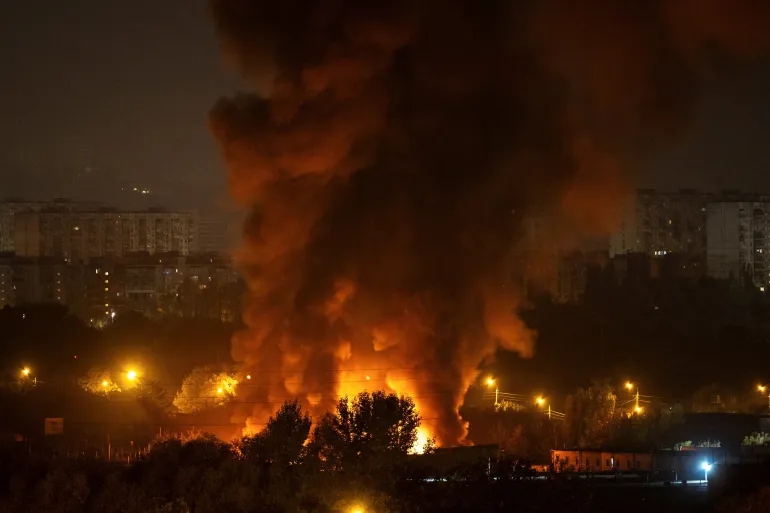
Russian missiles and drones struck Kyiv and several other Ukrainian regions on Wednesday, October 7, killing at least 28 people, including children, and injuring around 100, according to Ukrainian authorities. The deadliest attack hit a five-storey apartment building in Pryluky, Chernihiv region, where 20 people were reported killed, including five children. Casualties were also recorded in Kyiv, Kremenchuk and Oleksandria.
Russia’s Defence Ministry confirmed what it called a “massive” coordinated strike, saying land-, air- and sea-launched weapons and drones targeted Ukraine’s military-industrial complex. Moscow specifically said facilities associated with missile and drone production were hit in Kyiv, along with port and ship-repair infrastructure in the Odesa region. Ukraine says civilian residential areas were also struck. President Volodymyr Zelenskyy described the barrage as one of Russia’s most severe recent attacks and renewed appeals for additional Patriot air-defence systems. Ukrainian officials say ballistic missiles remain particularly difficult to intercept despite improved success against Russian drones.
Ukraine, meanwhile, is intensifying its own long-range campaign inside Russia. Kyiv has targeted oil refineries, fuel depots and military facilities, arguing that Russia’s petroleum industry directly finances and supplies Moscow’s war effort. Ukraine claims its strikes have disabled more than half of Russia’s refining capacity, although the full scale of that figure has not been independently confirmed.
The aerial confrontation intensified further after Ukraine launched hundreds of drones toward Russian territory, including Moscow and occupied Crimea. Russian authorities said most were intercepted, although some energy installations were hit. On the battlefield, the front remains largely characterised by slow, grinding territorial fighting rather than a major breakthrough. Russia continues pressing Ukrainian defensive positions in the east while Ukraine increasingly relies on drones and long-range attacks to disrupt Russian logistics and energy supplies.
Western support is also increasing. Germany recently announced an additional €1 billion in military assistance and €350 million for Ukrainian energy repairs, while Sweden is deploying Patriot systems to Poland to protect a NATO logistics hub used to supply Ukraine. The European Union has also approved a major expansion of sanctions targeting Russia’s missile, drone and defence-production industries, while adding measures against North Korean entities accused of assisting Moscow’s war effort.
For now, there is no clear diplomatic breakthrough. Instead, the conflict is increasingly becoming a contest of long-range strikes: Russia targeting Ukrainian cities and infrastructure, and Ukraine attempting to damage the energy and industrial systems that sustain Moscow’s military campaign.



















