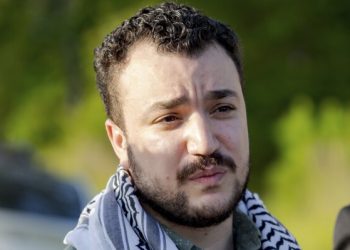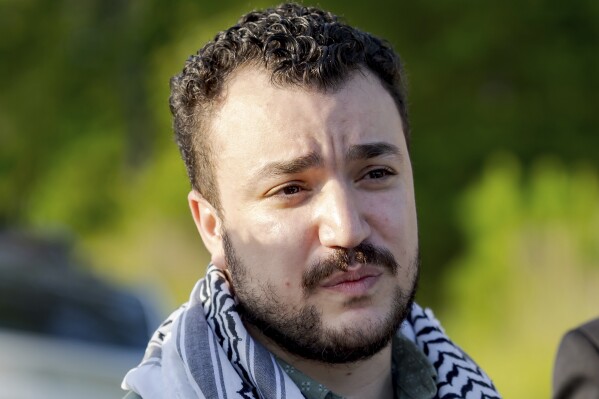
WASHINGTON — Mahmoud Khalil, a former Columbia University graduate student and prominent pro-Palestinian activist, plans to appeal to the U.S. Supreme Court after a federal appeals court refused to reconsider a ruling that could expose him to renewed detention and possible deportation.
Khalil’s lawyers said Friday they would ask the nation’s highest court to review the case and temporarily block the appeals court ruling from taking effect while the challenge continues. The decision followed a 6-5 vote by the 3rd U.S. Circuit Court of Appeals declining to rehear an earlier ruling that said a New Jersey federal judge lacked jurisdiction to order Khalil’s release from immigration detention.
Khalil, an Algerian citizen born in a Palestinian refugee camp in Syria, is a lawful permanent resident of the United States and is married to a U.S. citizen. He was arrested by immigration authorities in March 2025 after becoming one of the most visible figures in pro-Palestinian protests at Columbia University. He was detained for more than three months before a federal judge ordered his release.
The Trump administration has argued that Khalil can be deported under immigration law, citing national security and foreign policy concerns. Officials have also accused him of omissions in his green card application. Khalil denies wrongdoing, and his lawyers say the case is retaliation for constitutionally protected speech and advocacy on Palestine.
An immigration judge previously ruled that Khalil could be deported, and a later removal order listed Algeria or Syria as possible destinations. His legal team has warned that deportation to either country could endanger him, particularly given his Palestinian background and public activism.
Civil liberties groups, including the American Civil Liberties Union, say the case raises major constitutional questions about whether the government can detain and seek to remove a lawful permanent resident based on political expression. The ACLU said the appeals court ruling did not address the central First Amendment claims, but instead focused on whether federal courts could intervene before immigration proceedings were completed.
The case has become one of the most closely watched legal battles arising from the Trump administration’s crackdown on pro-Palestinian campus activism. Supporters of Khalil argue that the government is using immigration law to punish dissent. The administration says it is enforcing immigration and national security powers.
Khalil’s appeal is expected to test how far federal courts can go in reviewing deportation cases involving claims of political retaliation, free speech and executive authority over immigration.