

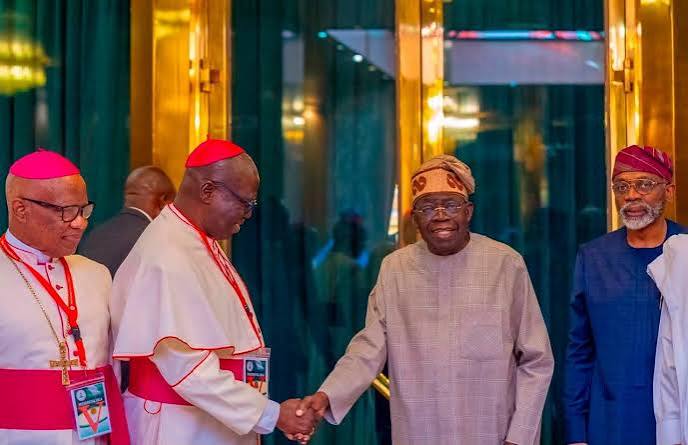
President Bola Tinubu has told Catholic bishops that Nigeria is gradually overcoming its economic and security challenges, expressing confidence that the country is heading towards greater prosperity.
The President made the statement on Tuesday at the State House, Abuja, during a meeting with a 20-member delegation of the Catholic Bishops’ Conference of Nigeria (CBCN), led by its president, Most Rev. Matthew Ndagoso, Archbishop of Kaduna.
Discussions at the meeting covered some of the country’s major challenges, including insecurity, poverty, education and the state of the economy. Tinubu said his administration was taking steps to strengthen security agencies and improve their capacity to respond to terrorism, banditry and kidnapping.
“We will defeat terrorism.”
According to the President, the Federal Government is improving intelligence gathering, providing additional equipment and strengthening logistics and welfare for security personnel deployed to troubled areas. He also disclosed plans to expand the Armed Forces and construct additional barracks.
Tinubu urged religious leaders to contribute to national security by speaking against violence and encouraging their followers to support peaceful coexistence. He said the government could not achieve lasting peace without cooperation from communities and faith-based organisations.
Turning to the economy, the President said the reforms introduced by his administration had helped stabilise the country after what he described as difficult economic conditions inherited by his government.
“This government has stabilised, and there is prosperity on the horizon. Life is improving.”
He also pointed to education, entrepreneurship and skills acquisition as important areas for reducing poverty and creating opportunities for young Nigerians. Tinubu highlighted the Nigerian Education Loan Fund (NELFUND) as one of the initiatives designed to widen access to higher education.
The President further cited the relative stability in the university system, noting that prolonged industrial actions that previously disrupted academic activities had been avoided. He described the development as an “answered prayer” and called for continued efforts to preserve stability.
For their part, the Catholic bishops raised concerns about insecurity, poverty and access to quality tertiary education. They also called for stronger democratic institutions and credible elections ahead of the 2027 general elections.
The CBCN additionally urged the Federal Government to consider restoring mission schools, arguing that such institutions could contribute to improving educational standards and values among young Nigerians.



















