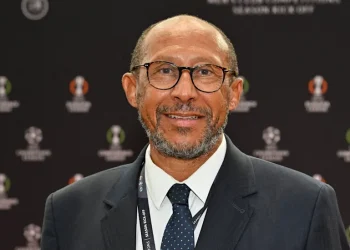
Nigerian football administrator Samson Adamu has been appointed acting secretary-general of the Confederation of African Football, CAF, in a move that gives Nigeria its first occupant of the organisation’s top administrative office since the continental body was founded in 1957. The appointment was approved on Sunday, March 29, during CAF Congress in Cairo after Adamu’s name was proposed by the CAF Executive Committee and ratified by Congress at the Giza Palace Hotel.
Adamu’s elevation followed the resignation of Swiss-Congolese official Veron Mosengo-Omba, who stepped down the same day. Before the appointment, Adamu served as CAF’s director of tournaments and events, a position in which he played a central role in the planning and delivery of major African football competitions. His promotion is being seen as a major moment for Nigerian football administration, placing a Nigerian at the heart of CAF’s day-to-day management for the first time in the organisation’s nearly seven-decade history.
The secretary-general is widely regarded as the administrative engine room of CAF, overseeing the body’s daily operations, legal and governance processes, and the implementation of decisions taken by the executive leadership. Adamu’s background in tournament organisation is likely to make continuity a key part of his immediate mandate, especially as CAF continues to manage a demanding calendar of competitions and institutional reforms. While the appointment boosts Nigeria’s visibility within African football politics, it also places Adamu in one of the most sensitive and influential non-elected roles in the continental game.
His rise comes at a significant time for CAF. Mosengo-Omba had been a prominent figure within the organisation and had also faced scrutiny in recent years, with Reuters reporting in 2024 that CAF opened an investigation into possible governance and auditing breaches within its secretariat, allegations he denied at the time. Against that backdrop, Adamu’s appointment is likely to be watched not only as a milestone for Nigeria, but also as part of CAF’s broader effort to steady and strengthen its internal administration.