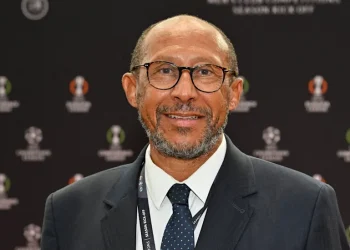
As Nigerians watch another FIFA World Cup without the Super Eagles, a recent comment by former Nigeria Football Federation president Amaju Pinnick has reopened a painful conversation about leadership, accountability and the culture of power in Nigerian football.
Speaking on Arise TV, Pinnick reportedly said he still works closely with the current NFF leadership and remains a “critical stakeholder” in the game. Then came the line that sparked debate: “To me, I’m the life president of the Nigerian Football Federation.”
It may have been said casually, perhaps even jokingly. But jokes often reveal more than prepared speeches. In a modern football federation, the phrase “life president” belongs nowhere near serious governance. Football institutions should be built on accountability, transparency and term limits, not on personal indispensability.
No one can deny Pinnick’s passion for the game. He loves Nigerian football and remains one of the country’s most visible football administrators. But passion is not the same as competence. Millions of Nigerians are passionate about football. The boy who treks several kilometres to pay ₦100 to watch a local league match is passionate too. The difference is that administrators are entrusted with structures, budgets, policies and decisions that determine whether national passion becomes international success.
Pinnick led the NFF from 2014 to 2022. He inherited a system already troubled by poor planning, weak grassroots structures, inconsistent funding and a struggling domestic league. But leadership is not judged only by what it inherits. It is judged by what it improves.
After eight years, Nigerian football still looked painfully familiar: unstable coaching decisions, weak youth development, poor league organisation, endless political manoeuvring and dependence on last-minute interventions. The Super Eagles qualified for the 2018 World Cup under his watch, but also failed to qualify for Qatar 2022 — a national embarrassment for a country with Nigeria’s population, football culture and talent pool.
Now Nigeria has also missed the 2026 World Cup. Pinnick is no longer NFF president, and Ibrahim Gusau must answer for the failures of the current administration. But if the structure handed over in 2022 was flawed, then the legacy conversation cannot exclude the man who led it for eight years.
This is why the “life president” comment landed badly. It sounded less like harmless banter and more like the old Nigerian problem of leaders refusing to leave the stage. Institutions cannot breathe when former officeholders remain too visible, too influential and too eager to define themselves as permanent fixtures.
Direct access to players is useful, but calling players does not replace building academies. It does not reform club licensing. It does not improve referee development. It does not create a sustainable football economy. It does not fix the domestic league or design a serious pathway from school football to professional football.
Pinnick deserves credit where it is due. During his tenure, the NFF became more visible internationally, improved some sponsorship conversations and strengthened relationships within CAF and FIFA circles. Those are part of his record. But they do not erase the failures, and they certainly do not justify the language of permanent ownership.
Nigeria’s football problems are structural, not personal. The solutions will come through reforms, data-driven planning, investment in coaching, stronger youth competitions, financial transparency and protection of the domestic league. They will not come from titles claimed in television interviews.
Former leaders can remain useful. They can advise privately, support reforms and open doors when invited. But they must also understand the discipline of stepping back. Chasing microphones after leaving office blurs the line between stakeholder and shadow administrator. It confuses the public about who is truly responsible for today’s decisions.
Amaju Pinnick’s “life president” line was a joke that landed wrong because Nigerian football is in no mood for jokes. The Super Eagles are absent from the World Cup again. Fans are angry. The system is tired. The country does not need echoes of old power; it needs sober builders.
Pinnick should remain a stakeholder, but from a respectful distance. Nigerian football belongs to the people, not to any former president — no matter how passionate, connected or influential he may be.