
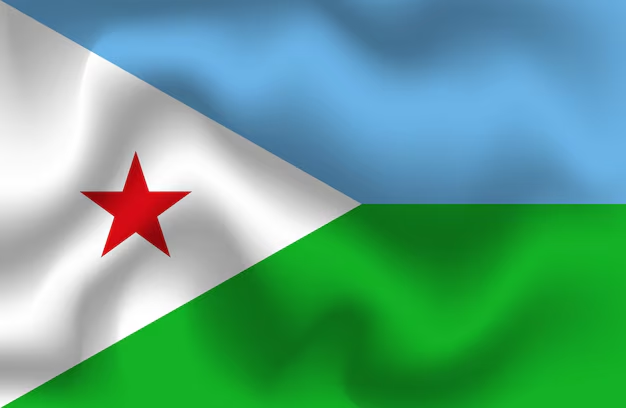
Djibouti heads into Friday’s presidential election with veteran leader Ismail Omar Guelleh widely expected to secure a sixth term, extending a rule that began in 1999 and reinforcing his grip on one of the Horn of Africa’s most strategically important states. At 78, Guelleh is among Africa’s longest-serving leaders and faces only one low-profile challenger, Mohamed Farah Samatar of the Unified Democratic Centre, a small opposition party with no parliamentary seats. Analysts say the outcome is unlikely to be in doubt.
Guelleh’s dominance has been helped by a fragmented opposition and a tightly controlled political environment. The election follows a constitutional change passed in October 2025 removing the presidential age limit of 75, clearing the way for him to run again after what had been expected to be his final term. Rights groups and analysts have criticised the amendment as another sign that political rules in Djibouti are being reshaped to preserve the incumbent’s hold on power.
The president continues to present himself as the guarantor of stability in a volatile region. Djibouti sits at the mouth of the Bab al-Mandeb Strait, one of the world’s busiest maritime chokepoints, and hosts military forces from the United States, France, China, Japan and Italy. It is home to the only permanent U.S. military base in Africa and serves as a key logistics and security hub for operations across the Horn and the Red Sea corridor. That strategic location has made the small country indispensable to global powers, even as critics accuse the government of repressing dissent and limiting political competition.
Regional tensions have only added to Djibouti’s geopolitical importance. To the south lies Somaliland, the self-declared republic whose independence was formally recognised by Israel in December 2025, a move that heightened anxiety across the Horn and drew criticism from several regional actors. With conflict in the Middle East also threatening shipping through nearby waters, Djibouti’s ports and military partnerships have become even more significant.
At home, however, the political picture is far less stable than the official narrative suggests. Djibouti ranks near the bottom of global press freedom tables, and activists say opposition voices remain marginalised. Omar Ali Ewado of the Djibouti League of Human Rights has described the election as a “masquerade,” arguing that Guelleh’s only opponent poses no real threat. For many observers, Friday’s vote is therefore less a competitive contest than a test of how long Djibouti’s entrenched system can continue unchanged.