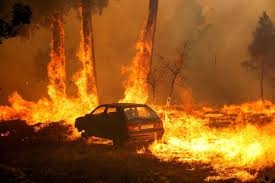
Massive wildfires continued to rage across the Iberian Peninsula on Monday, with thousands of firefighters, soldiers, and water-dropping aircraft deployed to battle the blazes. Since the fires began, at least six people have lost their lives.
Southern Europe has faced weeks of punishing heatwaves and drought, conditions scientists link to climate change, which have fueled widespread destruction. Spain alone has seen more than 343,000 hectares (848,000 acres) of land consumed by flames this year — the worst tally on record, according to the European Forest Fire Information System (EFFIS). The previous record of 306,000 hectares was set just three years ago.
The weekend proved especially deadly. Two firefighters — one in Spain and one in Portugal — died in separate road accidents, bringing the toll to four in Spain and two in Portugal. Additional casualties include two volunteer firefighters in Castile and Leon, a Romanian worker at a riding school near Madrid, and a former mayor in Portugal’s Guarda region.
Spain’s Civil Protection chief, Virginia Barcones, told national broadcaster TVE that 23 “active fires” posed a “serious and direct threat” to communities. Most of the blazes are concentrated in Galicia, Castile and Leon, and Extremadura.
In Galicia’s Ourense province, charred forests and gutted homes marked the aftermath. Thick smoke blanketed towns, forcing residents to wear masks. Locals joined firefighting crews, using buckets and hoses in desperation to protect their properties.
One man in O Barco de Valdeorras described the moment flames approached his home: “It came from below and it was like a hurricane. The good thing was that in two minutes it headed up and it didn’t stay here long. If not, our house would have been burnt, it would not have survived.”
Spanish Defence Minister Margarita Robles described the situation as “very difficult, very complicated,” noting that smoke plumes so dense they could be seen from space were limiting aerial firefighting operations.
Spain is receiving assistance from France, Italy, Slovakia, and the Netherlands, while Portugal has been reinforced with planes from Sweden and Morocco. Officials remain hopeful that relief is on the way, with Spain’s meteorological agency forecasting the end of the heatwave that sent temperatures soaring to 45°C.
Elsewhere in southern Europe, Turkey announced two major fires had been contained, while rain and cooler weather eased wildfire outbreaks in the Balkans.
Despite reinforcements, Portugal remains under strain, with 2,000 firefighters battling flames across the north and center of the country on Monday, half of them concentrated around the town of Arbanil. Nearly 216,000 hectares of land have been destroyed by fires there since the start of the year.