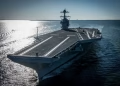
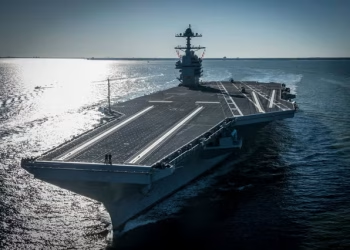
KINGSTON, Jamaica — The USS Nimitz, the oldest active aircraft carrier in the U.S. Navy, is expected to make what is likely to be its final overseas port call when it arrives in Jamaica on Monday, marking another symbolic step toward the end of more than five decades of service.
The nuclear-powered carrier, commissioned on May 3, 1975, is the lead ship of the Nimitz class and is now the longest-serving aircraft carrier in U.S. Navy history. It recently passed the service record set by the former USS Enterprise, which was commissioned in 1961 and inactivated in 2012.
The Jamaica visit comes during the ship’s final major overseas mission, which has included participation in Southern Seas 2026, a U.S. Southern Command deployment focused on maritime cooperation and exercises with partner nations in Latin America and the Caribbean. The deployment has included operations with regional navies and port visits in South America and the Caribbean.
The Nimitz has recently been operating in the Caribbean after completing exercises around South America, including activity near Chile, Argentina and Brazil. U.S. Southern Command confirmed earlier this month that the carrier strike group had entered the Caribbean Sea as part of its regional mission.
The carrier had been expected to begin the retirement process this year, but the Navy extended its service life to March 2027 to help maintain the legally required 11-carrier fleet while the newer USS John F. Kennedy continues preparations for active service.
During its long career, the Nimitz supported U.S. military operations across the Middle East, the Pacific and other regions. It also took part in the failed 1980 mission to rescue U.S. hostages in Iran and later supported operations in Iraq, Afghanistan and the Gulf.
The final overseas port call is expected to be both operational and ceremonial, giving sailors a chance to represent the Navy abroad while also marking the closing chapter of the carrier’s global deployments.
After completing its remaining duties, the Nimitz is expected to continue toward Naval Station Norfolk, Virginia, before eventually entering the long process of inactivation, defueling and decommissioning.
For the Navy, the visit represents the passing of an era. For the crew, it is a final opportunity to take one of America’s most recognisable warships into a foreign port before the carrier leaves frontline service.