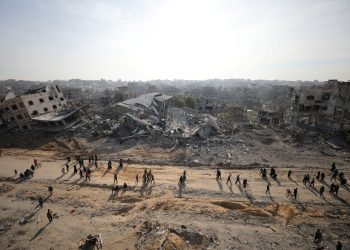
UN agencies have issued some of their starkest warnings yet over Sudan’s spiralling war, describing a country where famine is taking hold, disease is spreading and civilians are being hunted in their own streets.
Officials from the UN refugee agency (UNHCR), the World Health Organization (WHO) and the UN Mine Action Service (UNMAS) briefed reporters on Friday about the rapidly worsening situation, with particular alarm over atrocities in the city of El-Fasher in North Darfur.
Sudan’s conflict erupted in 2023 when tensions between the army and the paramilitary Rapid Support Forces (RSF) — former allies meant to shepherd a democratic transition after the 2019 uprising — exploded into full-scale war. At least 40,000 people have been killed and 12 million displaced, making Sudan one of the world’s largest displacement crises; aid groups believe the real death toll is far higher, given huge swathes of the country are inaccessible.
Last month, the RSF captured El-Fasher, the last major army stronghold in Darfur, after a prolonged siege. During and after the city’s fall, RSF fighters stormed the Saudi Hospital, killing more than 450 people, according to WHO, in one of the conflict’s single worst massacres. Witnesses say paramilitaries then fanned out through neighbourhoods, going house to house, executing civilians and carrying out sexual violence.
UNHCR says roughly 90,000 people have fled El-Fasher and nearby districts in just the past two weeks. Many are now stuck in perilous limbo, unable to move on because of ongoing attacks or the risk of being pushed back toward the front lines. “They are stranded… some with disabilities and other vulnerabilities, in places where they cannot safely go forward or back,” said Jacqueline Wilma Parlevliet, UNHCR’s head of sub-office in Port Sudan.
The humanitarian picture is dire nationwide. WHO’s Christian Lindmeier warned that over 21 million people — around 45% of Sudan’s population — are facing high levels of acute food insecurity, while famine has now been confirmed in El-Fasher and the town of Kadugli in South Kordofan. With health facilities destroyed or cut off, people are also dying from treatable illnesses, and Sudan is battling a growing cholera outbreak with more than 3,500 associated deaths reported.
UNMAS official Sediq Rashid highlighted the lethal legacy of landmines and unexploded ordnance, stressing that the conflict is playing out in cities and towns, where unexploded shells and improvised devices are killing and maiming civilians long after battles move on. Urban contamination, he said, is making already dangerous routes for displaced families almost impassable.
In Geneva on Friday, the UN Human Rights Council adopted a resolution — without opposition — instructing its existing team of independent experts on Sudan to urgently investigate the hospital killings and other violations in El-Fasher. The experts have been asked to identify alleged perpetrators “where possible,” with an eye toward future accountability.
But with aid blocked, famine spreading and shelling ongoing, UN officials warned that accountability will be cold comfort for those now on the brink of starvation. What Sudan needs most urgently, they said, is sustained humanitarian access — and a halt to the fighting that has turned El-Fasher and much of the country into a battlefield.