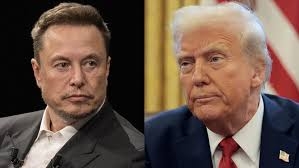
What once appeared to be one of the most improbable power alliances in American politics came crashing down on Thursday, as Donald Trump and Elon Musk traded barbs in a dramatic, highly public spat that played out across the airwaves and online platforms.
The former president didn’t hold back during an Oval Office media session, taking direct aim at Musk—his former top donor and onetime head of the federal cost-cutting Department of Government Efficiency. Responding to Musk’s blistering critique of a massive government spending bill, Trump expressed frustration and hinted at retaliation.
“I’m very disappointed in Elon. I’ve helped Elon a lot,” Trump said with visible irritation, flanked by visiting German Chancellor Friedrich Merz. “Look, Elon and I had a great relationship. I don’t know if we will anymore.”
Trump, who dubbed the legislation a “big, beautiful” bill, bristled at Musk’s scathing comments and threatened to void government agreements with Musk’s companies, including contracts for rocket launches and satellite services. The suggestion that he might revoke those deals—valued at over $18 billion—sent shockwaves through financial markets.
“Elon was ‘wearing thin,’ I asked him to leave,” Trump later declared on Truth Social. He added, “The easiest way to save money in our Budget, Billions and Billions of Dollars, is to terminate Elon’s Governmental Subsidies and Contracts.”
Musk was quick to respond—and unrelenting. Posting on his social platform X, the billionaire tech mogul fired off a series of sharp rebuttals, calling Trump’s statements “false” and accusing the president of failing to show gratitude.
“Without me, Trump would have lost the election, Dems would control the House and the Republicans would be 51-49 in the Senate,” Musk wrote. “Such ingratitude.”
In a move that intensified the conflict, Musk alluded to a long-simmering controversy by posting, “Trump is in the Epstein files,” referring to court documents connected to the late financier Jeffrey Epstein.
The clash had immediate consequences for Musk’s business empire. Tesla’s stock plummeted by around 15% amid the turmoil, erasing over $100 billion from its market capitalization in a matter of hours.
The friction had been building for months, despite the initial fanfare surrounding their collaboration. Musk’s appointment to DOGE was hailed as a bold move by Trump, who frequently praised the entrepreneur and invited him into his inner political circle. Their relationship was highly visible, with Musk traveling aboard Air Force One and making high-profile appearances at the White House and Mar-a-Lago.
But the partnership proved fragile. Musk, frustrated by political gridlock and clashing with members of Trump’s cabinet, resigned after just four months. Since then, tensions have simmered beneath the surface, only recently boiling over.
Trump speculated that Musk was struggling with his departure, stating, “Trump derangement system,” and alleging that the Tesla CEO had become “hostile” since leaving government service.
Musk, meanwhile, hinted at ambitions beyond Trump’s orbit. He floated the idea of launching a new political party through a poll on X—an idea that raised eyebrows across the Republican establishment, even though Musk, as a non-native citizen, is ineligible to run for president.
Though Musk’s $300 billion donation made him the largest backer of Trump’s 2024 campaign, it’s clear the goodwill didn’t last. As their fallout reverberated across political and financial spheres, attention briefly turned to the one person in the room who remained silent through the firestorm: Chancellor Merz.
Prepared for a contentious Oval Office visit, Merz instead watched quietly as Trump directed his fury at a different target altogether.