NEW YORK — Elon Musk’s SpaceX is preparing for what could become the largest initial public offering in history, targeting a valuation of about $1.77 trillion as investor demand for space, satellite internet and artificial intelligence infrastructure accelerates.
The company plans to sell about 555.6 million shares at $135 each, according to reports citing its latest filing. That would raise roughly $75 billion and make the listing far larger than Saudi Aramco’s 2019 IPO, which raised about $29.4 billion.
At the proposed valuation, SpaceX would rank among the world’s most valuable companies and could surpass Tesla’s market value. The offering is expected to list on Nasdaq under the ticker SPCX, with reports suggesting the debut could come as soon as this month.
The IPO would also significantly strengthen Musk’s control over one of the most strategically important private companies in the United States. Reports say Musk would retain more than 80 percent of the company’s voting power through a special class of shares, giving him firm control even after the public listing.
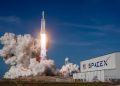
SpaceX has become dominant in global rocket launches through its reusable Falcon fleet and has built Starlink into one of the world’s largest satellite internet networks. The company is also investing heavily in Starship, its next-generation launch system intended for deep-space missions, larger satellite deployment and eventual Mars ambitions.
But the proposed valuation also reflects growing investor interest in SpaceX’s newer artificial intelligence plans. Reports say the company is pitching AI infrastructure, including space-based data centres and advanced computing services, as a major future growth opportunity.
The scale of the deal has raised questions among analysts. Barron’s reported that the IPO valuation would represent roughly 70 times estimated 2026 sales and 265 times 2025 EBITDA, making it one of the most aggressively priced major listings in recent memory.
SpaceX is also carrying heavy investment costs. AP reported that the company recorded a $2.6 billion loss on $18.7 billion in revenue, underscoring the risks behind its ambitious expansion.
A successful listing could push Musk closer to becoming the world’s first trillionaire, depending on how markets value his SpaceX and Tesla holdings. But it would also test whether public investors are willing to pay a historic premium for a company built around rockets, satellites and high-risk bets on future AI infrastructure.
For SpaceX, the IPO would mark a turning point from closely held private giant to public-market powerhouse. For Wall Street, it may become the defining technology listing of the decade.