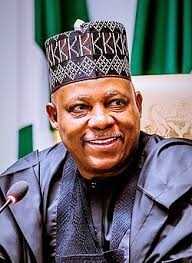
ABUJA, — Vice President Kashim Shettima returned to Abuja on Saturday after a week-long diplomatic and economic mission to Guinea-Conakry and Switzerland, telling reporters that Nigeria has “reclaimed a frontline seat” in global and regional policy conversations under President Bola Tinubu’s Renewed Hope agenda.
In Guinea, Shettima represented Tinubu at the inauguration of President Mamady Doumbouya, a ceremony Abuja framed as part of Nigeria’s effort to reinforce West African solidarity and its leadership role within ECOWAS while expanding bilateral economic corridors. Doumbouya, who seized power in a 2021 coup, was sworn in after a December 2025 election held under a new constitution that removed restrictions on military candidates and extended presidential terms—developments that have drawn scrutiny from critics and observers.
From Conakry, Shettima proceeded to Davos, where he led Nigeria’s delegation to the World Economic Forum (WEF) Annual Meeting, which the Nigerian government said took place from January 19–23, 2026. A central deliverable of the trip was the commissioning of “Nigeria House Davos,” described by the Presidency as Nigeria’s first sovereign pavilion on the Davos Promenade—intended as an investment-facing hub highlighting opportunities in solid minerals, agriculture, and the digital economy, and structured as a platform where private capital is expected to drive deal flow.
Shettima also used the WEF platform to position food security as a national stability issue, telling a session titled “When Food Becomes Security” that agriculture is being treated as a strategic pillar of national security and macroeconomic resilience.
On Africa-focused economic coordination, the Vice President joined former President Olusegun Obasanjo, former Vice President Yemi Osinbajo, and Finance Minister Wale Edun to advance the Accra Reset Initiative, which Nigerian officials characterised as an advocacy platform for African industrialisation driven by domestic capital and regional value chains rather than foreign aid.
On Nigeria’s outlook, Shettima told investors that macroeconomic indicators were “stabilising,” citing a projected 4.4% GDP growth in 2026 and an inflation decline to 12.94%, while also pointing to an “imminent” shift toward net exports of refined petroleum products anchored by the Dangote Refinery, alongside expanding exports of digital talent.