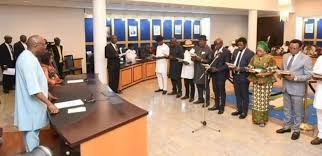
The Administrator of Rivers State, Vice Admiral Ibok-Ete Ibas (Rtd), has officially sworn in the 23 newly elected Local Government Chairmen, just hours after they received their certificates of return from the Rivers State Independent Electoral Commission (RSIEC).
In his remarks during the ceremony, Ibas reminded the new council bosses that public office should never be seen as a personal reward but as a duty to serve the people.
“This victory is not a prize to be enjoyed. It is a burden to be carried. It is not an entitlement, but a duty. It is not a call to self-interest, but to selfless service,” he said.
He urged the chairmen to reject politics of patronage, embrace accountability, and deliver reforms that directly impact grassroots communities.
The Rivers Administrator also recalled President Bola Tinubu’s March 18, 2025 declaration of a state of emergency in the state, stressing that the peaceful August 30 local government polls were a milestone in restoring democratic order.
“You proved that democracy belongs to the people, that power must flow from the consent of the governed, and that no obstacle can weaken the resolve of a united citizenry,” Ibas stated, commending voters for their discipline and active participation.
He further praised RSIEC for what he described as a transparent and violence-free election process.
Outlining his expectations for the new council executives, Ibas urged them to study the Nigerian Constitution and laws governing local government, describing them as the “compass of stewardship.” He advised them to work closely with traditional leaders, community stakeholders, and security agencies to ensure peace, warning:
“Without peace, there can be no progress.”
He further charged the chairmen to support small businesses, improve local infrastructure, invest in education, and align with the ongoing biometric enrolment of council staff to enhance payroll management and planning efficiency.
Ibas also took time to commend the outgoing Council Administrators for their contributions during what he called “a critical period in the state’s history.”