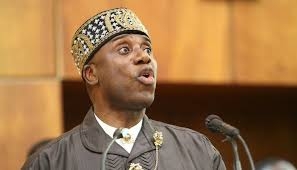
Nigeria’s Minister of Works, David Umahi, has stated that the Bola Tinubu administration inherited a near-vacuum of federal infrastructure projects in the South-East but has since initiated transformative road developments to fill the void.
Speaking at the All Progressives Congress (APC) National Summit in Abuja on Thursday, where the administration unveiled its two-year progress in the works sector, Umahi emphasized the renewed federal commitment to infrastructure across Nigeria.
“In the South-East, we inherited almost no project,” he said, referring to the state of affairs as of May 2023. “But today, we have the Owerri to Onitsha road ongoing, the Enugu to Onitsha project is ongoing, and so is the Enugu to Abakaliki road.”
He also noted that work on the pivotal Second Niger Bridge—linking Anambra and Delta states—has gained traction. “The Second Niger Bridge, serving both Delta and Anambra states, is also progressing steadily.”
Umahi praised President Tinubu for his strategic focus on infrastructure as a cornerstone of national development.
“Mr President, we may have challenges, but I must commend you very highly because you understand that it is the works sector that grows the GDP of a nation, upon which other sectors build. I feel privileged to work under you. You are a great man,” he stated.
He added that the quality of work under Tinubu’s leadership has not gone unnoticed by the public:
“I am very happy with what is happening on social media. People are commending you highly for the quality of work going on.”
One of the administration’s flagship projects, the Lagos-Calabar Coastal Highway, was highlighted as more than just a transportation route. Umahi described it as a long-term economic catalyst.
“Let me start with the Lagos-Calabar Coastal Highway and say that these four legacy projects are not just road projects — they are investment-driven projects. When completed, many of our existing roads across states will interconnect with this project,” he explained.
Section 1 of the highway, covering 47.47km of dual carriageway, is nearing completion, with work 80% finished. Section 2—stretching 55km to the Ogun border—is currently underway, and Umahi assured that a 10km portion would be ready by June 2025.
The Minister also touted the environmental and logistical innovations integrated into the project:
“We are using reinforced concrete with low emissions, and solar power energy will support parts of the project. The Apapa Wharf has a shallow draft, but with this road and connection to the deep seaport, we are now going to be transloading our goods. In addition, we will be earning carbon credits.”
Umahi drew attention to another ambitious initiative revived under Tinubu: the Sokoto-Badagry Highway. Originally proposed under President Shehu Shagari, the project had been shelved for decades.
“Mr President, the Shagari administration dreamt about the Badagry to Sokoto highway, but you came in and turned that dream into reality — from Sokoto to Badagry. That road stretches over 1,068km, and you insisted it be constructed in concrete pavement. We have already procured 258km (by two lanes) in Kebbi State,” Umahi said.
He revealed that the current administration took over 2,604 ongoing road projects valued at ₦13 trillion. Between 2023 and 2024, an additional 260 projects, amounting to ₦208 billion, were completed under Tinubu’s tenure.
The summit, which doubled as a policy showcase and political rally, was attended by President Tinubu, Vice President Kashim Shettima, Senate President Godswill Akpabio, House Speaker Tajudeen Abbas, National Security Adviser Nuhu Ribadu, APC Chairman Abdullahi Ganduje, and a host of party leaders and state governors.