

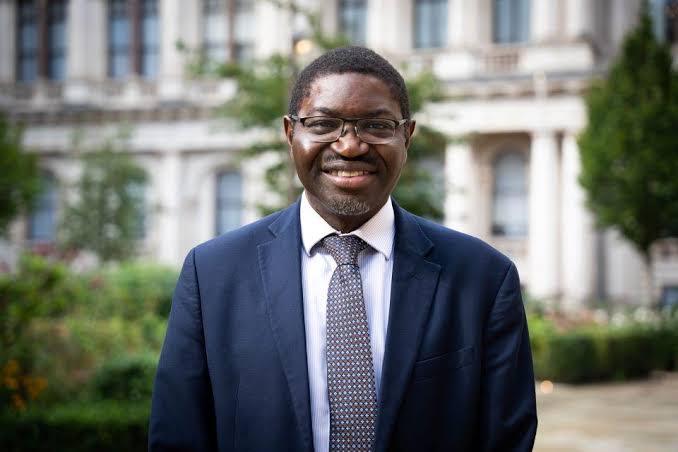
Nigerian-born law professor Dapo Akande has secured a place on the International Court of Justice (ICJ), returning Britain to the United Nations’ highest judicial body after losing its representation nearly nine years ago.
The Oxford University academic was elected on Tuesday, November 3, 2026, following separate voting exercises at the United Nations General Assembly and Security Council in New York.
Akande contested the election as the United Kingdom’s nominee and will serve a nine-year term beginning February 6, 2027.
He obtained 129 votes in the General Assembly, comfortably exceeding the 97 required for election, and received the necessary backing from the Security Council.
The outcome represents an important development for Britain, which had been without a judge at the court since 2017.
Four other candidates were elected alongside Akande. They are François Alabrune of France, Mahmoud Daifallah Hmoud of Jordan, Rena Lee of Singapore and Phoebe Okowa of Kenya.
Akande’s election has also attracted interest in Nigeria, where he began his legal education before establishing an international academic career.
He graduated from the University of Ife in 1992 with a law degree and completed his professional legal training at the Nigerian Law School the following year.
In 1994, he obtained a master’s degree in law from the London School of Economics and Political Science.
His career subsequently developed around public international law, a field concerned with the legal rights and obligations of countries and international institutions.
At the University of Oxford, Akande serves as Chichele Professor of Public International Law and is a fellow of All Souls College.
He also sits on the United Nations International Law Commission, which works on the development and clarification of international legal rules.
Beyond teaching and research, Akande has advised governments and international organisations on legal questions and participated in proceedings before international courts and tribunals.
Following his election, he thanked countries that supported his candidacy and reaffirmed his commitment to carrying out his judicial duties independently and impartially.
The British government also welcomed the result after supporting his candidacy through a diplomatic campaign.
Based in The Hague, Netherlands, the International Court of Justice is the principal judicial organ of the United Nations.
Its 15 judges consider disputes submitted by countries and issue advisory opinions on legal questions referred by authorised United Nations bodies and agencies.
Judges serve nine-year terms and are required to act independently rather than represent the political interests of their countries.
Although Akande has Nigerian roots, he was elected on the United Kingdom’s nomination, not as Nigeria’s representative.
His election brings a Nigerian-trained legal scholar into one of the world’s most prominent judicial institutions, where he will help determine important questions of international law.



















