

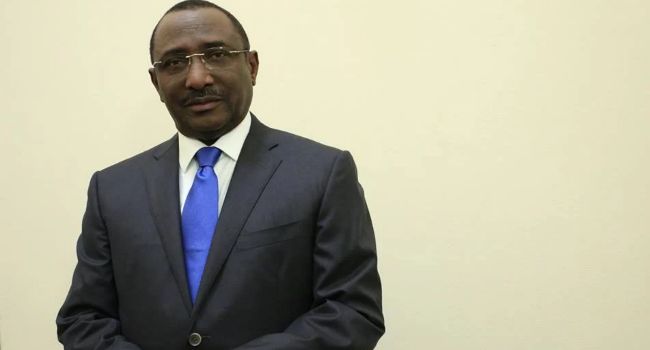
CONAKRY — Sidya Touré, a former prime minister of Guinea and one of the country’s most prominent opposition figures, has died in Paris at the age of 81, sources close to his family told AFP.
Touré died on Friday at the American Hospital of Paris after falling ill in Abidjan, Côte d’Ivoire, where he had been living in exile. Family sources told AFP he had been hospitalised in Paris for about two weeks before his death.
At the time of his death, Touré was leader of the Union of Republican Forces, UFR, one of Guinea’s major opposition parties. The UFR was among 40 political parties dissolved by Guinean authorities in March 2026, a move critics said further restricted political competition under President Mamady Doumbouya’s administration.
Touré had lived outside Guinea since the September 2021 military coup that brought Doumbouya to power and removed then-President Alpha Condé. Doumbouya later won the presidency in an election held without the participation of several major opposition parties, including the UFR, the UFDG and the RPG.
Cellou Dalein Diallo, leader of the Union of Democratic Forces of Guinea, UFDG, and another opposition figure living in exile, paid tribute to Touré on Facebook, describing him as “a friend and companion in the struggle” for Guinea. Diallo said Touré shared the dream of transforming Guinea into a prosperous country governed by democracy and the rule of law.
Touré was appointed prime minister in July 1996 by President Lansana Conté, who ruled Guinea from 1984 to 2008. He served until March 1999. His tenure was associated with administrative and economic reforms, as well as efforts to strengthen Guinea’s relationship with international financial institutions.
After leaving government, Touré became president of the UFR in 2000 and gradually emerged as a major opposition voice against successive governments. He contested Guinea’s presidential elections in 2010 and 2015 as the UFR candidate but did not win.
Born in 1945 in Côte d’Ivoire, Touré spent part of his professional life there, including in economic and financial administration, before becoming a central figure in Guinean public life.
Former President Alpha Condé, under whom Touré briefly served despite political disagreements, said it was “deeply regrettable” that a man who had given so much to Guinea endured exile at the end of his life. Current Prime Minister Amadou Oury Bah also paid tribute, describing Touré as a “pragmatic reformer” and a major figure in Guinea’s political life for three decades.
Touré’s death removes one of the last major figures from Guinea’s older generation of civilian political leaders at a time when the country’s opposition remains fragmented, weakened by exile, party dissolutions and restrictions on political activity.



















