

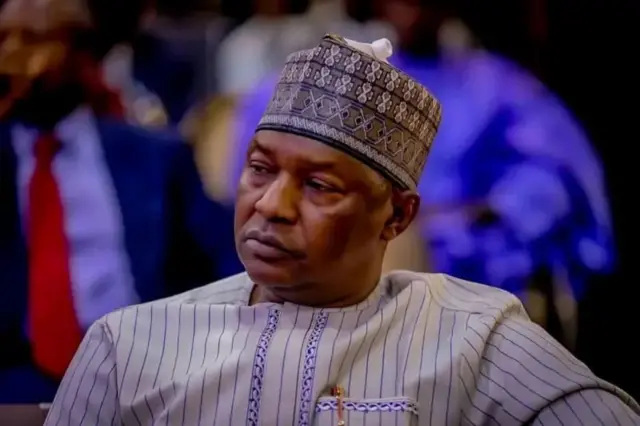
Former Attorney-General of the Federation and Minister of Justice, Abubakar Malami, has rejected the International Chamber of Commerce tribunal’s findings concerning his role in a controversial settlement over the Mambilla Hydroelectric Power Project.
Malami said the ICC proceedings were commercial arbitration and should not be interpreted as a criminal case against him. His response followed the tribunal’s September 16, 2026 final award in Paris, which dismissed claims brought by Sunrise Power and Transmission Company Limited against Nigeria.
The dispute centres on settlement agreements signed in January and March 2020 involving Sunrise and the Federal Government. Under the original agreement, Nigeria was to pay $200 million, while the subsequent addendum introduced a further $200 million liability in the event of default, potentially taking the exposure to $400 million, in addition to interest.
In its 616-page award, the three-member tribunal found that Malami and the then Minister of Power, Saleh Mamman, did not have the authority to bind the Federal Government to the agreements without the required presidential approval. It further held that the settlement documents were unenforceable because they were products of corruption and contrary to Nigerian public policy.
Malami’s response, issued through his Special Assistant on Media, Mohammed Doka, disputed the characterisation of the findings as a corruption conviction.
“The proceedings were commercial arbitration proceedings between parties to a dispute. They were not a criminal prosecution of Abubakar Malami, SAN, and the award does not constitute a criminal conviction of him.”
The tribunal, however, made specific findings about Malami’s conduct during the settlement negotiations. It said he acted against Nigeria’s interests and found evidence of what it described as a corrupt arrangement involving him and Leno Adesanya, the promoter of Sunrise.
Evidence considered by the arbitrators included communications between Malami and Adesanya while Nigeria and Sunrise were on opposing sides of the wider dispute. Adesanya also alleged that Malami had sought a share of the proposed settlement and said he possessed recordings of their conversations, although those recordings were not produced before the tribunal.
The tribunal said the evidence before it supported the existence of an improper arrangement between the two men. It nevertheless did not find that any portion of the additional $200 million default liability had actually been promised to Malami or Mamman.
The arbitration ultimately went against Sunrise. The tribunal rejected the company’s claims against Nigeria and ordered Sunrise and Adesanya to reimburse Nigeria about $11.82 million in legal expenses, as well as $414,125 in arbitration costs.
Nigeria’s own counterclaim for damages was also unsuccessful. The tribunal said the government had not established the necessary causal connection between the conduct it complained about and the financial losses for which it sought compensation.
Malami has also maintained that the Mambilla dispute predates his tenure as Attorney-General. The wider controversy concerns the development of the 3,960-megawatt Mambilla Hydroelectric Power Project in Taraba State and has generated contractual and arbitration disputes involving Sunrise and the Nigerian government.
The Nigerian government has welcomed the ICC outcome, describing it as a significant victory in the long-running dispute. President Bola Tinubu said the ruling rejected claims connected to the Mambilla project, while the State House credited the Federal Ministry of Justice and other members of Nigeria’s defence team for the result.
The case has also attracted the attention of the Economic and Financial Crimes Commission. According to reporting published after the award, the EFCC has constituted a team to examine individuals and transactions mentioned in connection with the Mambilla dispute. That reported investigation is separate from the ICC arbitration and should not be confused with a criminal conviction.
For Malami, however, the distinction remains central to his response: he accepts that the tribunal ruled in Nigeria’s favour but rejects the suggestion that the arbitral findings amount to a criminal judgment against him.



















