

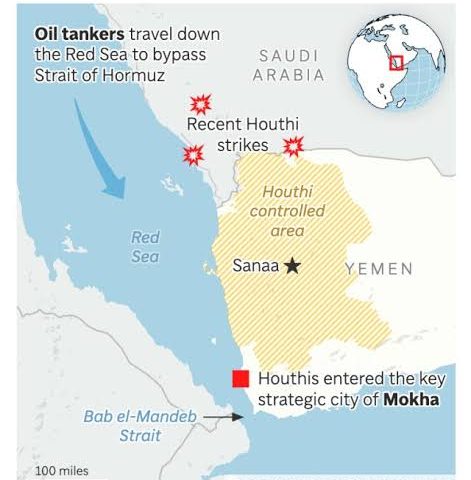
SANAA — Iran-aligned Houthi forces have seized control of Yemen’s Red Sea coast after a rapid advance against Saudi-backed government forces, raising fresh concern over one of the world’s most important shipping corridors.
The advance gives the Houthis greater control near the Bab al-Mandab strait, the narrow passage linking the Red Sea to the Gulf of Aden and the Indian Ocean. The group captured the strategic port city of Mokha on Thursday and later seized Mayun, also known as Perim Island, off Yemen’s coast, according to officials cited by The Associated Press.
The gains come amid a wider regional escalation involving Iran, Saudi Arabia, Iraq and the United States. Saudi Arabia has suspended operations on its crucial East-West oil pipeline as a precaution after drone attacks struck sections of the system in the Riyadh and Madinah regions. The Saudi Ministry of Energy said the pipeline was hit by multiple attacks on Thursday, while the Foreign Ministry said the drones were launched from Iraq and caused injuries and damage.
Riyadh has not immediately retaliated. Saudi reports said the kingdom held off after a request from Iraqi Prime Minister Ali al-Zaidi, giving Baghdad time to investigate and prevent further attacks. The Iraqi government later said it had opened an inquiry into the operations command in Maysan province and dismissed a commander after authorities determined that attacks targeting Saudi Arabia were launched from a site in the province.
The East-West pipeline, also known as Petroline, is strategically important because it allows Saudi crude from the Gulf side of the kingdom to reach the Red Sea port of Yanbu, bypassing the Strait of Hormuz. The Wall Street Journal reported that the pipeline can carry up to seven million barrels of crude a day over roughly 750 miles.
The simultaneous pressure on Yemen’s Red Sea coast and Saudi oil infrastructure has sharpened concerns that Iran and its allies are increasing pressure on US-aligned Gulf states. The Houthis have renewed attacks on Red Sea shipping and Saudi-backed forces this year, saying their actions are linked to the wider war involving Iran and the United States.
Iranian officials have praised the Houthi advance. The Islamic Revolutionary Guard Corps congratulated the group, with spokesman Sardar Mohebi describing the seizure of the Red Sea coast as a “divine triumph” and the result of years of steadfastness. Mohammad Mokhber, an adviser to Iran’s supreme leader, also said the “homegrown resolve” of the resistance had driven the United States and its allies into a strategic impasse.
The Houthis’ expanded position along the coast could allow them to threaten shipping with artillery, drones or missiles from shorter range, increasing risks for commercial vessels moving between Europe and Asia. Al Jazeera reported that the group’s control of the coast and nearby islands has strengthened its hold on the corridor.
The advance has also worsened Yemen’s humanitarian crisis. The Guardian reported that nearly 50,000 civilians have fled as fighting spread along the Red Sea coast, adding to displacement in a country already devastated by years of war.
For Saudi Arabia, the pipeline attack threatens a vital export route at a time when shipping through Hormuz remains unstable. For Yemen, the Houthi gains mark a major battlefield shift. For the wider region, both developments point to a conflict increasingly fought through maritime chokepoints, proxy forces and energy infrastructure.



















