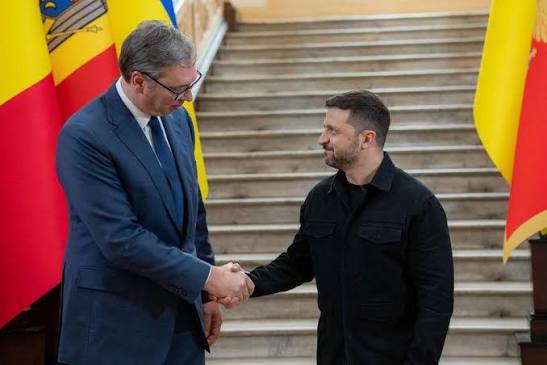
Ukrainian President Volodymyr Zelenskyy has arrived in Belgrade for his first official visit to Serbia, opening talks with President Aleksandar Vučić at a time when Kyiv is seeking broader European partnerships while Serbia continues to maintain close relations with Moscow. The visit began on Friday and continues into Saturday.
The trip carries unusual diplomatic significance because Serbia has sought to balance its longstanding relationship with Russia with its ambition to join the European Union. Belgrade has condemned Russia’s invasion of Ukraine and provided humanitarian assistance to Kyiv but has not joined Western sanctions against Moscow.
Zelenskyy said the discussions with Vučić and Serbian Prime Minister Đuro Macut would focus on practical areas where both countries could cooperate. Economic relations, ties with the European Union and security are among the issues on the agenda.
“Important talks are scheduled for today and tomorrow.”
The Ukrainian president’s visit is also notable because it represents his first trip to Serbia since Russia launched its full-scale invasion of Ukraine in 2022. Earlier Ukrainian officials had maintained contacts with Serbian leaders, including a visit by Foreign Minister Dmytro Kuleba and First Lady Olena Zelenska to Belgrade in 2024.
For Vučić, hosting Zelenskyy provides an opportunity to demonstrate Belgrade’s willingness to maintain dialogue with Kyiv while preserving its traditional relationship with Moscow. Serbia has repeatedly said it supports Ukraine’s territorial integrity but has resisted pressure to adopt the European Union’s sanctions regime against Russia.
The Serbian president’s balancing act also extends to the country’s European ambitions. Serbia remains an EU candidate and has been urged by European officials to align more closely with the bloc’s foreign and security policies. EU Council President António Costa said in June that Serbia’s accession prospects depend partly on reforms and alignment with EU policies.
The meeting therefore extends beyond a routine bilateral engagement. For Kyiv, direct contact with Belgrade offers an avenue for strengthening relations with a country that has historically maintained strong political and cultural connections with Russia.
Economic cooperation is another potential area of interest. Zelenskyy’s stated agenda indicates that both governments are looking at ways to expand relations despite their different positions on the war.
The discussions also come as Ukraine continues to seek diplomatic support from European states while pursuing its broader relationship with the EU. Serbia’s geographical position and regional influence make its engagement with Kyiv particularly significant.
For Belgrade, the visit reinforces its strategy of maintaining communication with competing international partners. For Kyiv, it represents an attempt to deepen engagement with a European state whose foreign policy has traditionally been more closely associated with Moscow.
The talks could therefore have implications beyond the immediate relationship between Ukraine and Serbia, particularly as Belgrade continues to navigate its EU aspirations alongside its longstanding partnership with Russia.