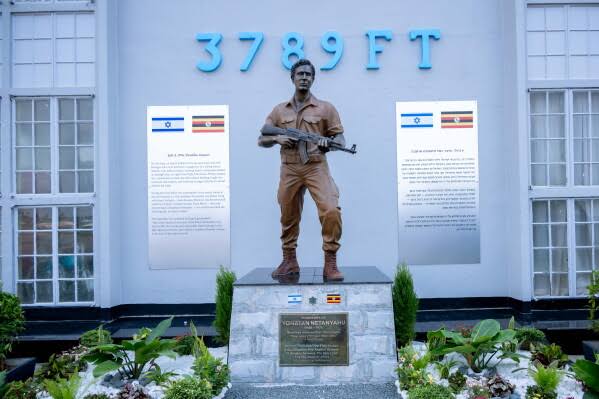
Uganda has unveiled a monument honouring Lt. Col. Yonatan “Yoni” Netanyahu, the Israeli military commander who lost his life during the historic 1976 Entebbe hostage rescue operation. The statue was unveiled outside the old terminal at Entebbe International Airport, the location where the daring rescue mission unfolded nearly five decades ago.
The memorial was commissioned by Uganda’s Chief of Defence Forces, Gen. Muhoozi Kainerugaba, who said the tribute recognises Netanyahu’s courage and leadership during one of the world’s most renowned counter-terrorism operations. Israeli representatives, business leaders and invited guests attended the unveiling ceremony in Entebbe.
“Today, this memorial stands not only in remembrance of a distinguished soldier, but also as a tribute to the enduring values he embodied: courage in the face of danger, unwavering commitment to protecting innocent lives, and steadfast devotion to duty.”
Yonatan Netanyahu, the elder brother of Israeli Prime Minister Benjamin Netanyahu, commanded the elite Israeli force that stormed the airport on the night of July 3, 1976, to rescue passengers aboard Air France Flight 139, which had been hijacked by Palestinian and German militants. Although the operation succeeded in freeing more than 100 hostages, Netanyahu was fatally wounded, becoming the only Israeli commando killed during the mission.
The Entebbe operation remains one of the most studied hostage rescue missions in modern military history. Israeli commandos completed the mission in less than an hour, rescuing the vast majority of captives, while several hostages and dozens of Ugandan soldiers also died during the exchange of gunfire. The raid later became known in Israel as Operation Yonatan in honour of its fallen commander.
Relations between Uganda and Israel have evolved considerably since the era of former Ugandan leader Idi Amin, whose government had supported the hijackers and severed diplomatic ties with Israel. In recent years, both countries have strengthened cooperation in areas including security, agriculture and trade, with Ugandan authorities describing the memorial as another symbol of the renewed relationship.
The unveiling has generated international attention because of the historical significance of the Entebbe rescue and the political symbolism attached to the monument. While many observers have described the memorial as a recognition of bravery during a landmark military operation, others have noted that the raid remains a subject of historical and diplomatic debate because it took place on Ugandan territory without the approval of the government then in power.
The monument now stands at Entebbe International Airport as a permanent reminder of an operation that shaped military history and continues to influence discussions on counter-terrorism, hostage rescue and Uganda–Israel relations nearly 50 years after the dramatic events of 1976.