

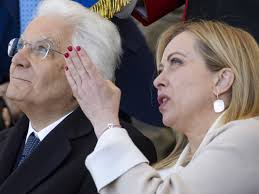
Italian Prime Minister Giorgia Meloni has accused United States President Donald Trump of fabricating a claim that she “begged” him for a photograph during the Group of Seven summit in Évian, France.
Meloni issued a strongly worded video response on Friday, saying she was “stunned” by Trump’s remarks and insisting that neither she nor Italy would ever plead for such treatment.
“I was frankly astonished,” Meloni said, rejecting the claim as “completely made up.” She added: “Italy and I do not beg.”
The dispute began after Trump told Italian television channel La7 that Meloni had asked him repeatedly for a photo during the G7 summit. He claimed he agreed only because he felt sorry for her. His comments quickly triggered anger in Rome and drew criticism from across Italy’s political spectrum.
Meloni, once regarded as one of Trump’s closest ideological allies in Europe, said the remarks were disrespectful not only to her personally but also to Italy. She accused Trump of treating allies with less respect than adversaries and said the episode showed a troubling approach to international relations.
The row has added fresh strain to relations between Rome and Washington, which have already been tested by disagreements over the US-Israeli war with Iran, NATO strategy and Trump’s criticism of Pope Leo XIV. Meloni has sought to maintain strong ties with the United States while also defending Italy’s independent position on major foreign policy issues.
Italian Foreign Minister Antonio Tajani cancelled a planned trip to the United States following Trump’s remarks, calling them offensive to Italy. The cancellation also led to the postponement of a US-Italy business conference in Miami. Defence Minister Guido Crosetto also defended Meloni, saying the prime minister would never need to request a photograph from anyone.
The White House has not issued a detailed public response to Meloni’s rebuttal.
The incident marks a sharp deterioration in the relationship between two leaders who had previously shared a nationalist and conservative political outlook. It also comes as G7 leaders attempt to maintain unity over global security, trade and China, despite deep divisions over Trump’s foreign policy.
For Meloni, the public denial was aimed at defending national dignity. For Trump, the controversy risks further alienating a European partner at a time when Washington is seeking support for its broader geopolitical agenda.



















