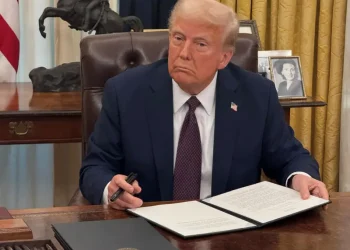
WASHINGTON — President Donald Trump has announced that the United States will deploy an additional 5,000 troops to Poland, reversing an earlier Pentagon decision that had raised concern in Warsaw and among NATO allies.
Trump said the troops would be sent to strengthen the U.S. military presence in Poland and reinforce NATO’s eastern flank. The announcement came shortly after reports that the Pentagon had cancelled the planned rotation of more than 4,000 U.S. soldiers from the 2nd Armored Brigade Combat Team, based at Fort Hood, Texas, to Poland. That decision had alarmed Polish officials, who warned it could send the wrong signal to Russia at a time of heightened tension in Europe.
In a post on Truth Social, Trump said he would now send “an additional 5,000 troops to Poland,” citing his strong relationship with Polish President Karol Nawrocki, whom he endorsed during last year’s election. The move has been welcomed by Poland but has also added to confusion among European allies over Washington’s wider troop posture in Europe.
Poland already hosts about 10,000 U.S. troops, mostly on rotational deployments, as part of NATO’s deterrence mission following Russia’s full-scale invasion of Ukraine. The country is also home to the forward headquarters of the U.S. Army’s V Corps at Camp Kościuszko in Poznań, a key command hub for American ground forces in Europe.
The new deployment comes amid broader debate inside Washington over whether the United States should reduce its military footprint in Europe and shift more resources toward the Indo-Pacific and the Western Hemisphere. The Associated Press reported that NATO allies were bewildered by the sudden reversal, coming only weeks after the Pentagon signalled cuts to European deployments.
Polish leaders have long pushed for a stronger and more permanent U.S. presence, arguing that Poland’s location on NATO’s eastern edge makes it central to deterring Russia. Warsaw has also offered to invest in infrastructure to host American forces.
For NATO, the decision provides short-term reassurance to Poland and other eastern members. But it also highlights uncertainty over U.S. strategy, with allies still unsure whether Washington intends to deepen its European commitments or gradually reduce them.