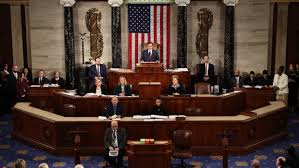
The United States Congress has urged President Donald Trump to sustain pressure on Nigeria through sanctions and other policy measures over what lawmakers described as worsening persecution of Christians, a claim Abuja firmly denies.
The recommendations followed months of inquiry by a congressional panel established after Nigeria was redesignated as a Country of Particular Concern (CPC). Lawmakers called on the President to formally enforce the CPC designation, publicly name perpetrators of violence, impose sanctions, and retain visa restrictions.
Describing Nigeria as “the deadliest place in the world to be a Christian,” the panel alleged that armed Fulani militias and terrorist groups have carried out killings, kidnappings, and the destruction of churches and schools. It also criticised the application of Sharia codes and blasphemy laws in parts of northern Nigeria, urging their repeal on grounds that they are used to silence dissent and marginalise minorities.
Congress further proposed withholding certain US funds until Nigeria demonstrates concrete steps to curb violence, directing a Government Accountability Office audit of American aid, tightening anti-money laundering systems, enhancing counter-terrorism collaboration, and encouraging divestment from Russian military hardware in favour of US equipment. Lawmakers also called for measures to counter Chinese influence, including alleged illegal mining operations.
Additional proposals included negotiating a bilateral security pact to protect vulnerable Christian communities, bolstering early-warning systems, deploying adequate security personnel to the Middle Belt, reclaiming farmlands from armed groups, facilitating the return of displaced persons, and implementing disarmament and reintegration programmes.
In a statement on X, Representative Riley M. Moore said the report followed hearings, fact-finding visits to Nigeria, and consultations with religious and government leaders.
“Our brothers and sisters in Christ have suffered in silence for too long. The world is now watching,” he said, urging Nigeria to strengthen cooperation with Washington to tackle insecurity.
Responding, Nigeria’s Minister of Information and National Orientation, Mohammed Idris, rejected suggestions of state-backed religious persecution.
“Nigeria does not have, and has never had, a state policy of religious persecution,” he said, attributing violence to terrorism, banditry, organised crime, and communal clashes rather than religious targeting.
Idris said the Federal Government has intensified military and law enforcement operations, improved intelligence coordination, deployed specially trained forest guards, and acquired modern security equipment. He also cited humanitarian support for internally displaced persons and ongoing peacebuilding efforts.
“The Federal Government will continue to engage international partners through appropriate diplomatic channels while remaining focused on its primary duty — the protection of all Nigerians,” he added.
The Christian Association of Nigeria (CAN) warned that calls to repeal Sharia and blasphemy laws risk inflaming religious tensions.
A senior CAN officia cautioned that constitutional amendments affecting Sharia could destabilise the country, noting that Muslim clerics within the Nigeria Inter-Religious Council consider the system integral to the culture of some northern communities.
Rather than abolishing Sharia provisions, CAN advocated drafting a new, inclusive constitution that reflects the interests of all religious and ethnic groups. “Religion is extremely sensitive,” the official said, stressing that while abuses must not be justified under religious law, comprehensive constitutional reform — not selective repeal — offers a more sustainable route to national unity.