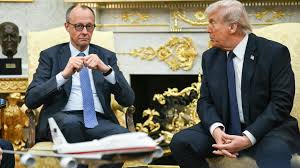
US President Donald Trump publicly criticised key European leaders during a White House meeting with German Chancellor Friedrich Merz, exposing fresh tensions over the escalating conflict with Iran.
Speaking in the Oval Office, Trump faulted British Prime Minister Keir Starmer for declining to allow US forces to use British bases in the Chagos Islands for offensive operations against Iran. “This is not Winston Churchill that we’re dealing with,” Trump said. He also warned Spanish Prime Minister Pedro Sánchez of a potential full US trade embargo after Madrid opposed American strikes.
Merz, who remained largely silent during the exchange, later said he had “addressed both issues very clearly in a personal conversation … because he didn’t want to air the conflict publicly.”
The remarks highlight growing friction between Washington and its European partners as US and Israeli operations against Iran intensify. European governments have attempted to balance support for Gulf allies and continued cooperation under NATO’s security framework with domestic opposition to a war many consider legally contentious.
Germany, France and the UK — the E3 — issued a joint statement condemning Iran’s retaliation and calling for a “resumption of negotiations,” but stopped short of explicitly backing or criticising the US-Israeli strikes.
On Wednesday, NATO air defences intercepted an Iranian missile heading toward Turkish airspace, the first reported instance of the alliance downing a missile bound for a member state.
While refraining from offensive action, some European countries have bolstered defensive deployments. Starmer confirmed Britain would permit US use of its bases for “defensive strikes” on Iranian missile facilities and has dispatched helicopters with anti-drone systems and a warship to Cyprus following a drone strike on a British base there. French President Emmanuel Macron announced the deployment of a French frigate to Cyprus along with “additional air defense assets.”
London stressed that its role is limited to “collective self-defense of regional allies who have requested support” and “specific and limited defensive action,” adding that it “does not signal the UK having any wider involvement in the broader ongoing conflict.”
Macron described the US-Israeli strikes as “conducted outside the framework of international law,” while assigning “primary responsibility for this situation” to Iran.
Sánchez has been among Europe’s most vocal critics of Washington’s approach, rejecting calls for Spanish participation. “We’re not going to be complicit in something that’s bad for the world, nor contrary to our values and interests simply to avoid reprisals from someone,” he said in a televised address.
The dispute comes amid evolving US explanations for the strikes on Iran. Trump and senior officials have offered differing accounts of the “imminent” threat posed by Tehran’s nuclear programme, dismissing intelligence assessments suggesting Iran would not be capable of developing an intercontinental ballistic missile before 2035.
With memories of the 2003 Iraq War still politically sensitive, European leaders face mounting domestic pressure as they navigate the expanding Middle East crisis.