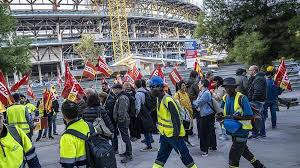
NUUK, Greenland — Hundreds of demonstrators gathered in Greenland’s capital, Nuuk, as the United States opened a new consulate, protesting President Donald Trump’s renewed interest in the semi-autonomous Danish territory and warning Washington to respect Greenlandic self-determination.
Protesters carried Greenlandic flags and placards rejecting any attempt to expand U.S. control over the Arctic island. Many chanted “No means no,” while others held signs reading “Greenland belongs to Greenlanders” and “USA, stop it,” reflecting widespread anger over Trump’s repeated comments about acquiring or increasing American influence over Greenland.
The new U.S. consulate in downtown Nuuk is larger than Washington’s previous diplomatic presence on the island. U.S. officials said the mission would strengthen engagement with Greenland, deepen cooperation and support local partnerships. But for many residents, the opening came at a politically sensitive moment, amid concern that diplomacy is being used to advance American strategic ambitions in the Arctic.
Greenland’s Prime Minister Jens-Frederik Nielsen and several other political leaders declined invitations to attend the opening, a move widely seen as a sign of resistance to Washington’s approach. U.S. Ambassador to Denmark Kenneth Howery used the ceremony to stress partnership and said Washington supported Greenland’s right to determine its own future.
Tensions have been heightened by comments from U.S. special envoy Jeff Landry, who said it was time for America to “put its footprint back” on Greenland. His visit to the island, reportedly without a formal invitation, drew criticism from Greenlandic and Danish officials, who said future engagement should take place through official channels involving Greenland, Denmark and the United States.
Greenland, home to about 57,000 people, is part of the Kingdom of Denmark but has broad self-government and growing aspirations for full independence. The island’s strategic location between North America and Europe, its mineral resources and its importance to Arctic security have made it increasingly significant as global competition in the region intensifies.
The United States already maintains a military presence in Greenland, including an active base, and officials have discussed possible future defence investments under existing security agreements. Those plans have added to local unease, especially after Trump previously refused to rule out stronger measures to secure U.S. interests on the island.
For protesters in Nuuk, the message was direct: Greenland is open to cooperation, but not coercion. As one slogan put it, the island is not for sale — and its future must be decided by Greenlanders themselves.