A black box flight recorder has been recovered from the charred wreckage of an Air India Dreamliner that crashed into a residential neighborhood in Ahmedabad, claiming the lives of at least 265 people on Thursday. The aircraft, bound for London’s Gatwick Airport, went down shortly after takeoff, striking a medical hostel and nearby canteen during the midday crash.
The Boeing 787-8, carrying 242 passengers and crew, issued a distress call moments after liftoff, before failing to gain altitude and slamming into the densely populated area just outside the airport perimeter.
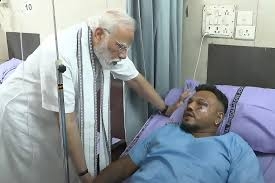
Miraculously, one passenger survived the fiery disaster. Speaking from a hospital bed, British citizen Vishwash Kumar Ramesh recalled the moment everything changed.
“Initially, I too thought that I was about to die, but then I opened my eyes and realised that I was still alive,” he told national broadcaster DD News, his voice shaken.
Eyewitnesses said the front of the aircraft landed on a student canteen while the tailpiece remained wedged in the upper floors of a staff hostel. Authorities confirmed that at least 24 people on the ground were also killed in the impact.
“The official number of deceased will be declared only after DNA testing is completed,” Home Minister Amit Shah stated. Samples are being collected from victims’ families, many of whom live abroad, to aid in the identification process.
According to Air India, those on board included 169 Indian nationals, 53 British, seven Portuguese, a Canadian, and 12 crew members.
Prime Minister Narendra Modi visited the crash site and spent time at the hospital with Ramesh, the lone survivor, who offered a chilling account of the moments before the crash.
“Everything happened in front of me, and even I couldn’t believe how I managed to come out alive from that,” he said. “Within a minute after takeoff, suddenly… it felt like something got stuck… I realised something had happened, and then suddenly the plane’s green and white lights turned on.”
Meanwhile, heartbroken families gathered at an emergency support center in Ahmedabad to provide DNA samples and search for missing loved ones. Among them was Ashfaque Nanabawa, looking for his cousin Akeel, who had boarded the flight with his wife and young daughter.
“He called us and he said, ‘I am in the plane and I have boarded safely and everything was okay’. That was his last call,” Nanabawa recounted.
A grieving mother-in-law, whose son-in-law was among the dead, sobbed, “My daughter doesn’t know that he’s no more. I can’t break the news to her, can someone else do that please?”
Local volunteers who rushed to the site described a scene of devastation.
“The bodies were totally burnt. It was like coal,” said Bharat Solanki, a fuel station worker who helped retrieve victims.
One nearby doctor, identified only as Krishna, said “One-half of the plane crashed into the residential building where doctors lived with their families.”
The crash is the first known fatal incident involving a Boeing 787 Dreamliner. Boeing has said it is working closely with Air India and authorities and is ready to provide technical assistance.
Air safety agencies from the UK and US have dispatched teams to collaborate with India’s investigation.
Tata Group, which owns Air India, pledged ₹10 million (around $117,000) in compensation to each bereaved family and committed to covering the medical expenses of the injured.
India has a history of aviation tragedies, including the 1996 mid-air collision over New Delhi that killed almost 350 people and the 2010 Mangalore crash, which resulted in 158 deaths.
Aviation experts urged caution in speculating on the cause of Thursday’s incident, though some floated mechanical failure as a likely factor.
“The aircraft is designed to be able to fly on one engine, so the most likely cause of the crash is a double engine failure. The most likely cause of a double engine failure is a bird strike,” said Jason Knight, a fluid mechanics expert at the University of Portsmouth.
India’s airline sector has seen exponential growth, with the International Air Transport Association recently calling the expansion “nothing short of phenomenal.” Now the world’s fourth-largest air travel market, India is projected to rise to third place within the next decade.
But the tragedy in Ahmedabad serves as a grim reminder of the risks that still haunt one of the fastest-growing aviation sectors in the world.