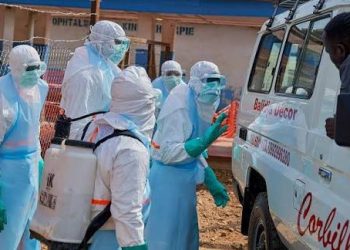
Kenya has confirmed its first-ever Ebola case and death, after a Kenyan man who had been living in the Democratic Republic of Congo died in Nairobi on Monday night, October 5. Kenya’s Ministry of Health says laboratory testing at the National Virology Reference Laboratory and KEMRI confirmed Bundibugyo Ebola virus disease.
The patient, described by officials as a 40-year-old Kenyan businessman, had lived in the DRC for about seven years. He became ill roughly a month ago and received treatment at several health facilities there before travelling overland to Kampala, Uganda, and then flying to Nairobi on October 3.
Despite undergoing routine health screening at Jomo Kenyatta International Airport, he was allowed through. Relatives later took him to Nairobi Hospital, where he was isolated after presenting with fever, chills, severe fatigue, muscle pain, difficulty swallowing and bleeding beneath the skin. He died at about 11:30 p.m. on October 5. Kenyan health officials said medication may have suppressed his fever and helped him pass airport screening.
Authorities have identified 28 close contacts, including relatives and healthcare workers. Eight family members and 21 healthcare workers who attended to the patient have been quarantined and are being monitored. Officials are also tracing 23 passengers and four crew members who travelled on his Jambojet flight from Uganda to Kenya.
So far, Kenya says no additional positive cases have been confirmed. Health Minister Aden Duale said that of 267 samples tested during the country’s surveillance programme, only this patient’s sample had returned positive.
The case is linked to the much larger Ebola epidemic in the Democratic Republic of the Congo. The outbreak, caused by the relatively rare Bundibugyo strain, has produced more than 8,000 cases and more than 4,000 deaths. It has also previously produced cases in Uganda and France. The Africa Centres for Disease Control and Prevention is sending a high-level team to Kenya, while the World Health Organization is supporting the Kenyan and Ugandan responses. WHO has not recommended travel restrictions against affected countries.
Kenya says it has trained nearly 5,000 healthcare workers for Ebola prevention and management and remains on heightened alert. The immediate focus is determining whether the imported case resulted in any secondary transmission in Nairobi or among people who travelled with the patient.