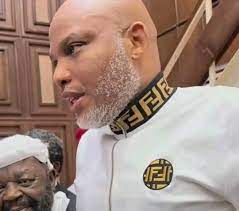
The conviction and life imprisonment of Indigenous People of Biafra (IPOB) leader, Mazi Nnamdi Kanu, on terrorism charges has sparked quiet but intense debate across Owerri, the Imo State capital.
Though discussions were observed in markets, motor parks and street corners, many residents were reluctant to speak publicly, reflecting the sensitivity and deep emotions surrounding the case.
Chief Simeon Odike said he was not surprised by the judgment, pointing to what he described as a long history of disobeyed court orders in Kanu’s favour.
“Have we not lost count of the judgments in favour of Mazi Nnamdi Kanu? Was any of the judgments obeyed? Has anybody paid him the monetary award for damages ordered by competent courts of the land?” he asked.
Odike also recalled that several prominent Igbo leaders, clerics and at least 44 members of the National Assembly had appealed to President Bola Ahmed Tinubu to explore a political solution and release Kanu, but said those efforts appeared to have had little impact on the eventual outcome.
For Mr. Luke Okechukwu, the ruling was a painful missed opportunity to calm tensions in the South East.
“I am saddened by the judgment of the Federal High Court. The mood of the people amply exhibits the inner feelings of the populace,” he said.
“The court can give justice but definitely not peace, because they are two different things. There could have been a subtle, pleasurable, political solution to this case instead of relying fully on our judicial system.”
Mrs. Adaora Ike Okoro, who has followed the case since Kanu’s first arrest in 2015, said the life sentence did not come as a shock. She recalled the 2017 military invasion of Kanu’s ancestral home in Afara Ukwu, Abia State, and the subsequent escalation of tensions.
“For anyone who has been following this case to date, today’s judgment is not surprising,” she said, noting that it was “most interesting that the court session was streamed live by major national television stations,” allowing people across the country and in the diaspora to watch proceedings in real time.
The reactions in Owerri mirror broader divisions across the South East, where Kanu’s supporters insist he is a political prisoner, while others worry about the security and economic fallout of prolonged agitation. For many residents, the central questions of justice, political inclusion and lasting peace in the region remain far from resolved.