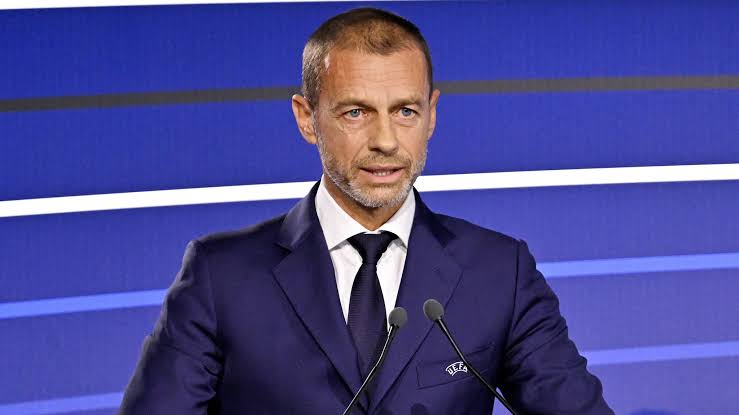
UEFA President Aleksander Čeferin has reversed his earlier decision to step down and confirmed that he will seek a fourth and final term as head of European football’s governing body, potentially extending his leadership until 2031.
The 58-year-old Slovenian announced his decision on Thursday, October 8, during a meeting in Berlin attended by presidents and general secretaries of UEFA’s 55 national football associations.
Čeferin, who has led UEFA since 2016, said he had reconsidered his position following unanimous appeals from the member associations urging him to continue in office.
He will seek re-election at the 51st UEFA Ordinary Congress, scheduled for April 22, 2027, in Astana, Kazakhstan.
In a statement published by UEFA, Čeferin thanked the national associations for their confidence and said he believed important work remained unfinished.
He explained that his ambition was to maintain unity within European football, strengthen the organisation and prepare it for future leadership.
Reversal of 2024 Decision
Čeferin’s announcement represents a significant reversal of his position in February 2024, when he publicly declared that he would not seek another term after his current mandate expired in 2027.
That announcement followed controversy surrounding changes to UEFA’s statutes that made it possible for him to contest another presidential election.
The amendments attracted criticism from those who questioned whether extending presidential eligibility was consistent with governance reforms intended to prevent excessive concentration of power.
Despite those concerns, UEFA’s national associations have now collectively encouraged Čeferin to remain in office.
If re-elected, he would begin a fourth term and continue leading the organisation until 2031.
His decision comes at a sensitive period for European football, with UEFA facing questions involving governance, competition structures, commercial interests and its relationship with world football’s governing body, FIFA.
UEFA Calls for Change in FIFA Leadership
The Berlin meeting also produced a significant development in the increasingly strained relationship between UEFA and FIFA President Gianni Infantino.
UEFA announced that 54 of its 55 national associations, with Azerbaijan the sole exception, had endorsed proposals for reforming FIFA’s governance and leadership.
The associations expressed a loss of confidence in FIFA’s current leadership and argued that structural reforms alone would not adequately address their concerns.
They called for a new president capable of rebuilding trust among football’s governing organisations and strengthening institutional independence and accountability.
The dispute follows opposition to Infantino’s proposal to involve private investors in a new commercial entity managing rights associated with FIFA competitions, including the World Cup.
That proposal was subsequently abandoned.
Infantino has also proposed an independent review of FIFA’s decision-making processes and consultations on possible governance improvements.
Čeferin Rules Out FIFA Presidency
Despite UEFA’s calls for new leadership at FIFA, Čeferin has ruled out personally challenging Infantino in the FIFA presidential election scheduled for March 2027.
His decision to remain at UEFA means he will continue overseeing European football while discussions proceed over potential alternatives to Infantino.
Former Switzerland international Ramon Vega has announced his intention to contest the FIFA presidency.
The former Tottenham Hotspur defender is seeking the necessary support to become an official candidate ahead of the nomination deadline.
UEFA has confirmed that further discussions on FIFA reform and leadership will take place before November 17, 2026, when another meeting of its national associations is expected.
What the Decision Means for European Football
Čeferin’s candidacy comes at a time when UEFA is seeking to maintain cooperation among its member associations while addressing disagreements with FIFA over commercial development, competition management and governance.
His continued leadership would provide continuity for UEFA’s ongoing projects, although the 2027 presidential election has yet to take place.
The decision also renews attention on the debate surrounding presidential term limits and accountability within international sports organisations.
For now, Čeferin remains UEFA president, with his next term dependent on the outcome of the April 2027 election.