WASHINGTON — The U.S. House of Representatives has approved a war powers resolution seeking to halt further American military action against Iran unless President Donald Trump receives explicit authorisation from Congress.
The measure passed on Wednesday by 215 votes to 208, with four Republicans joining Democrats in a rare bipartisan challenge to Trump’s handling of the Iran conflict. It marked the first time the House successfully approved such a resolution after several earlier attempts failed or were delayed.
The resolution, sponsored by Democratic Representative Gregory Meeks of New York, would direct the president to withdraw U.S. forces from hostilities with Iran unless Congress formally approves continued military operations. Supporters said the vote was intended to reassert Congress’s constitutional authority over decisions of war and peace.
House Republican leaders had previously cancelled a vote on the measure before the Memorial Day recess after it appeared close to passing. Speaker Mike Johnson had sought to avoid a floor defeat that would expose growing unease among Republicans over the war, but opposition increased as the conflict continued and Trump struggled to secure a lasting deal with Tehran.
The four Republicans who supported the resolution were Thomas Massie of Kentucky, Brian Fitzpatrick of Pennsylvania, Tom Barrett of Michigan and Warren Davidson of Ohio, according to reports.
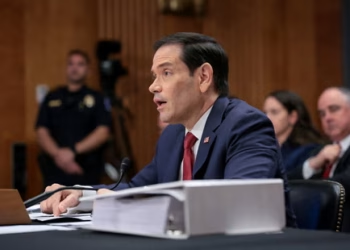
The Trump administration has argued that the president acted within his authority to protect U.S. forces and interests. Secretary of State Marco Rubio warned lawmakers that passing a war powers measure could weaken Washington’s negotiating position by making Iran believe the administration’s “hands are going to be tied.”
The conflict began after joint U.S. and Israeli strikes on Iran in late February. Although a ceasefire was announced in April, tensions have persisted, particularly over shipping through the Strait of Hormuz and Iran’s nuclear programme.
The resolution now moves to the Senate, where a similar measure advanced last month with support from four Republican senators. It still faces major obstacles, including the likelihood of a presidential veto if it reaches Trump’s desk.
Even so, Wednesday’s vote was politically significant. It showed that congressional patience with the Iran war is weakening and that some Republicans are willing to challenge Trump on military authority.
For the White House, the vote adds pressure as diplomacy continues. For Congress, it marks a renewed attempt to reclaim a role in decisions that could determine whether the U.S. remains at war or moves toward a negotiated settlement.