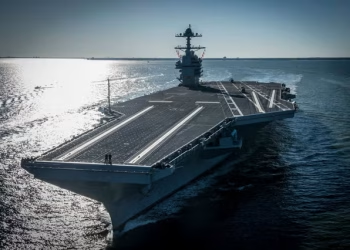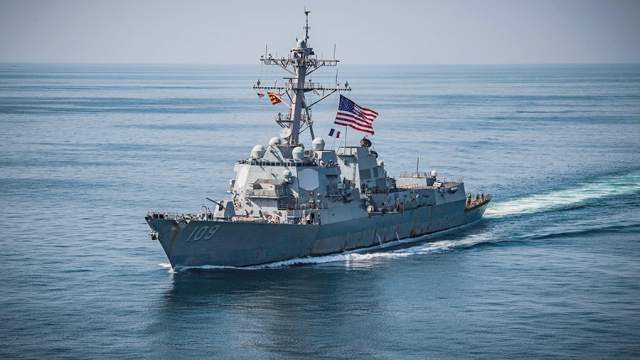
WASHINGTON — The U.S. Navy could use unconventional methods to quickly increase its missile firepower while it waits for new warships to be built, according to a new Congressional Budget Office analysis.
The report examined ways the Navy could expand the number of missile-carrying vessels without relying only on traditional shipbuilding, which can take years and face cost overruns. One proposal would add missile launchers to existing ships that do not normally carry them, including amphibious and logistics vessels. Another would reactivate and arm ships such as littoral combat ships, which have faced criticism over cost, survivability and mission limitations.
The CBO said such options could add as many as 69 missile-carrying ships and up to 640 missile launchers to the Navy’s inventory. Supporters argue the approach could give commanders more firepower in a crisis, especially in the Indo-Pacific, where the U.S. is preparing for the possibility of conflict with China over Taiwan or control of key sea lanes.
The idea reflects a broader shift in naval planning. Rather than waiting only for destroyers, submarines and future frigates, the Navy is exploring ways to distribute weapons across more platforms, including smaller ships, support vessels and unmanned systems.
The service is also developing containerised weapons systems that can be placed on drone ships or traditional warships. These modular containers could carry missiles, sensors or electronic-warfare equipment, allowing vessels to be adapted quickly for different missions.
Defence analysts say the concept could help address a major U.S. challenge: China has rapidly expanded its navy and missile forces, while American shipbuilding has struggled to keep pace. Adding launchers to existing vessels could be faster than building new combatants from scratch.
However, the approach carries risks. Ships not originally designed for missile combat may lack the sensors, command systems, protection and survivability of dedicated warships. Arming logistics or amphibious vessels could also make them higher-value targets in a conflict.
The Navy is also experimenting with armed uncrewed vessels. Reuters reported last year that Lockheed Martin planned to modify Saildrone vessels to carry advanced weapons, including anti-ship missiles and potentially Tomahawk missiles in future versions.
The push comes as modern naval warfare is being reshaped by drones, long-range missiles and cheaper precision weapons. Recent conflicts have shown that both offensive firepower and defensive depth can matter as much as the number of traditional warships.
For the Navy, unconventional firepower may offer a near-term bridge: not a replacement for a larger fleet, but a faster way to add missiles while shipyards work to deliver the next generation of vessels.