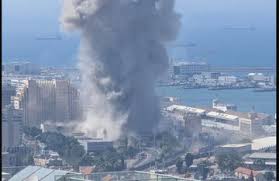
Emergency crews rushed to the northern Israeli city of Safed after a rocket fired from Lebanon struck a parking area, damaging vehicles and prompting a rapid response by ambulances, firefighters and Home Front Command personnel as authorities searched for debris and possible unexploded material. The strike came amid sustained exchanges between Israel and Hezbollah that have intensified in recent days despite wider regional ceasefire efforts involving Iran. Reuters reported on April 9 that Hezbollah launched missiles toward northern Israel after accusing Israel of violating understandings linked to the broader truce.
Israeli rescue teams moved quickly to secure the impact site, check nearby buildings for damage and restrict access around the affected area. Local reporting said the hit in Safed damaged a parking lot and at least one emergency vehicle, while residents were urged to remain close to protected spaces as alerts continued across the north. Safed lies roughly 35 kilometres from the Lebanese border and has repeatedly come under threat as the Israel-Hezbollah front remains active.
One important caution is that current reporting does not clearly support the claim that several people were injured in the Safed incident. The strongest available reports I found focused on property damage and emergency deployment, with some local accounts saying there were no immediate injuries at the impact site. That makes the strike significant less because of mass casualties than because it shows how northern Israeli communities remain under constant pressure from recurring rocket fire even when attacks cause limited physical damage.
The Safed strike unfolded as the wider Lebanon front remained highly volatile. Reuters reported that Israel has continued heavy strikes inside Lebanon after insisting that the U.S.-Iran ceasefire does not apply to Hezbollah. Those attacks triggered retaliatory rocket launches by Hezbollah, which said it was responding to what it viewed as Israeli violations. The result has been a dangerous disconnect: diplomacy has reduced some pressure on one part of the regional war, but not on the Israeli-Lebanese front, where exchanges are still ongoing.
For civilians in northern Israel, that means daily life remains shaped by warning sirens, disrupted movement and the risk of sudden impacts. Authorities in Safed later began assessing the damage and clearing the area, but the broader picture remains unchanged: even when rockets cause only limited structural damage, they keep communities on edge and reinforce the sense that the northern front remains unresolved.