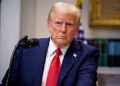
U.S. President Donald Trump said on Wednesday that he had been told “on good authority” that executions in Iran had stopped and that there was “no plan for executions,” amid continuing reports of a violent crackdown on nationwide anti-government protests.
Trump’s remarks come against a backdrop of sharply disputed casualty figures and limited independent verification due to Iran’s restrictions on information flows, including an internet blackout and tight controls on local reporting. Rights monitors and media accounts have described mass arrests, the deployment of anti-riot forces, and a sustained security presence in Tehran and other cities since demonstrations began in late December over worsening economic conditions and later broadened into political protests.
In recent days, indications from Iranian authorities and state-linked messaging have pointed in the opposite direction of Trump’s assertion, with reports suggesting that Tehran may be moving toward expedited legal proceedings and potential capital punishment for some detainees accused of serious offences.
Separately, Iran’s Foreign Minister Abbas Araghchi, speaking in a televised interview, dismissed speculation that the government intended to carry out hangings in connection with the unrest, saying “hanging is out of the question,” while also accusing Washington of issuing threats and backing sanctions.
The U.S. administration has framed its posture as support for protesters and pressure on Iran’s leadership, with Trump repeatedly warning Tehran against using lethal force. Iran, in turn, has warned that any U.S. military intervention would trigger retaliation against American interests and regional assets, raising concerns about escalation.
Analysts note that the gap between Trump’s claim and ongoing reports underscores the challenge of confirming developments inside Iran in real time. With communications constrained and independent access limited, assessments of whether executions have in fact been halted—and whether any new death sentences are pending—remain difficult to substantiate publicly.
Iranian authorities have not immediately provided detailed, independently verifiable confirmation of Trump’s claim.