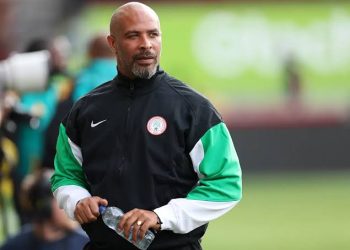
Ibrahim Musa Gusau says he chose to leave the presidency of the Nigeria Football Federation because he believes Nigerian football needs a new direction, after consulting his family, friends and stakeholders in the sport. His resignation came with 34 days remaining on his four-year tenure.
Speaking at a press conference in Abuja on Thursday, Gusau said his decision was motivated by his commitment to Nigeria and his desire to see the country’s football make progress. He said the decision followed consultations rather than being taken alone.
“I have decided to resign my position as the President of NFF, after consultations with my family and friends.”
Gusau also linked his decision to what he described as the need to put the country’s interest ahead of individual positions. The NFF said he regarded his resignation as a step towards an orderly and comprehensive reform of Nigerian football.
“My resignation is intended to give way to a comprehensive and orderly reform process aimed at addressing the longstanding institutional, governance and developmental challenges confronting Nigerian football.”
His decision came after a difficult period for Nigeria’s national teams. The Super Eagles failed to qualify for the 2026 FIFA World Cup, while the Super Falcons missed the 2027 Women’s World Cup for the first time since the competition began in 1991.
The pressure on the federation had also grown around questions concerning the administration of Nigerian football. A fact-finding process was established following the Super Falcons’ failure to qualify for the next Women’s World Cup, adding to scrutiny of the federation’s leadership.
There was also an ongoing investigation into the use of a N12 billion Federal Government intervention fund released to the NFF. The Economic and Financial Crimes Commission confirmed on August 28 that its investigation into the fund was continuing. However, Gusau did not publicly identify that investigation as the reason for his resignation.
Instead, the former NFF president maintained that he had made his decision after considering the wider situation in Nigerian football and consulting people close to him and stakeholders within the game.
Gusau also said he had encouraged members of the NFF board who were prepared to follow his decision to resign. He could not, however, immediately say how many had formally submitted their resignations to him.
“I have also advised my board members who are willing to tow the same path to resign as well.”
The former federation president did not portray his departure as an end to his involvement in football. He said he remained willing to contribute to the development of the sport whenever his experience was needed.
Gusau also defended what he considered the achievements of his administration, pointing to developments in coaching education, refereeing, domestic football and other areas. He said the federation had organised CAF C and B Licence programmes and was preparing to begin a CAF A Licence course on September 16.
He said those efforts should be considered alongside the setbacks experienced by the national teams. His argument was that his administration had made progress in some areas even though Nigeria had suffered important failures on the international stage.
The leadership change has now triggered a broader reform process. The NFF has confirmed that preparations for the September 27 elective congress have been suspended, while an interim arrangement has been put in place to oversee the federation’s secretariat during the transition.
For Gusau, however, the explanation for his exit remains straightforward: after consultations with those around him and against the backdrop of mounting problems in Nigerian football, he decided that stepping aside was the better option for the sport and the country.